Government health schemes were created to make quality treatment accessible to millions of beneficiaries.
Private hospitals became essential partners in this mission by providing specialist consultations, surgeries, cancer care, emergency services and advanced treatment where public-sector capacity was limited.
But an important question is now emerging:
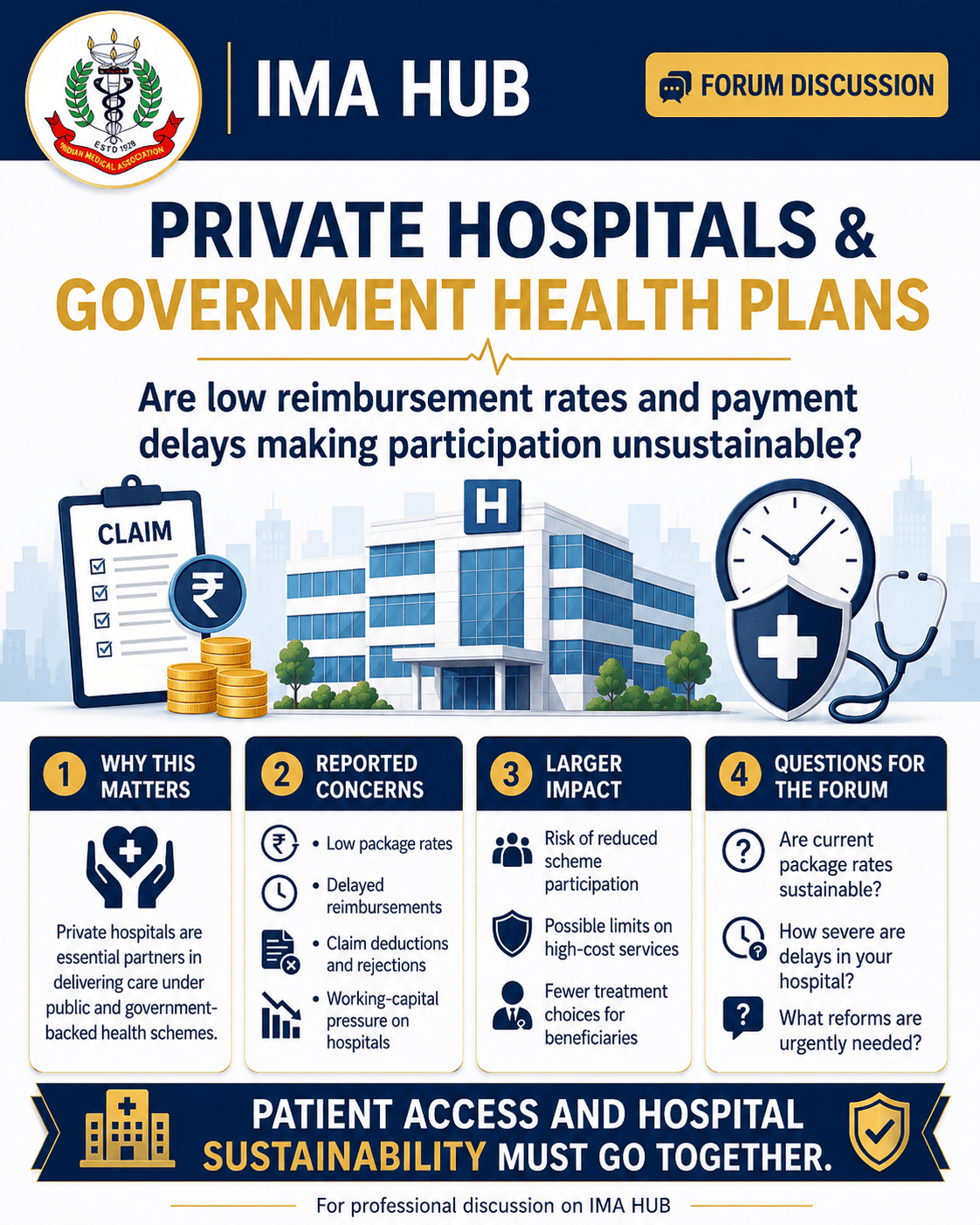
Can hospitals continue serving government-scheme patients when reimbursement rates do not reflect actual treatment costs and payments remain pending for long periods?
Why this discussion matters
A recent Economic Times report suggests that some leading private hospital groups are reassessing their participation in government health programmes because of low reimbursement rates, delayed payments, pricing restrictions and increasing pressure on working capital. While large hospital chains have not formally announced a complete withdrawal, some have reported financial impact, capped scheme volumes or changed their payer mix. (The Economic Times)
According to the report, government schemes such as CGHS and ECHS may contribute around 25% of revenue for many leading private hospitals. Industry estimates suggest that this contribution could fall by approximately 3–5% by the first quarter of FY27 through selective de-empanelment or restricted bed allocation. (The Economic Times)
What hospitals are facing
The reported concerns are not limited to profitability alone.
Hospitals participating in government schemes may have to manage:
- Package rates that may not match current costs of medicines, implants, consumables, manpower and infrastructure.
- Long settlement cycles and delayed reimbursement.
- Deductions or claim rejections after treatment has already been provided.
- Price caps on drugs and procedures.
- Significant working-capital pressure.
- Difficulty maintaining the same quality standards at unsustainable package rates.
Max Healthcare reportedly estimated a substantial continuing revenue impact associated with CGHS arrangements, including discount requirements on chemotherapy medicines. Narayana Health has also reportedly controlled scheme volumes in some hospitals because of payment delays and reimbursement restrictions. (The Economic Times)
The larger concern
This should not become a debate between patient welfare and hospital sustainability.
Both are interconnected.
If reimbursement systems become financially unviable, hospitals may:
- Limit the number of scheme beds.
- Restrict certain high-cost procedures.
- Delay expansion of services.
- Prefer patients with faster payment cycles.
- Voluntarily leave selected schemes.
This could ultimately reduce treatment choices for government employees, pensioners, defence personnel and other beneficiaries who depend on empanelled hospitals.
What requires urgent attention
A sustainable government–private healthcare partnership requires:
1. Scientific package-rate revision
Rates must be periodically updated using actual treatment costs, inflation, staff expenses, medicine prices, implant costs and quality requirements.
2. Time-bound claim settlement
Hospitals should receive payment within a defined period, with transparent tracking and accountability for delays.
3. Standardised deductions and rejection rules
Claims should not be reduced using unclear or inconsistent interpretations after services have been delivered.
4. Separate pricing for complex cases
Cancer care, intensive care, trauma, implants and high-risk procedures may require flexible or severity-linked reimbursement.
5. Digital transparency
Hospitals should be able to track claim submission, queries, approval, deductions and payment status through a common digital system.
6. Representation of treating hospitals
Rate revisions and operational rules should involve clinicians, hospital administrators, professional bodies and smaller nursing homes—not only large chains.
Important issue for smaller hospitals
Large corporate hospitals may have stronger cash reserves and diversified revenue sources.
Small and medium-sized hospitals, however, may face a greater risk. When payments remain pending for months, they must still pay salaries, vendors, pharmacies, laboratories, utilities and statutory expenses.
For such hospitals, delayed reimbursement is not merely an accounting issue—it can directly affect continuity of services.
Discussion
Government schemes are essential for expanding healthcare access. Private hospitals are equally essential for delivering that care.
The real solution is not withdrawal—it is the creation of a fair, transparent and financially sustainable partnership.
Members are invited to share:
- What percentage of your hospital’s patients come through government schemes?
- What is the average payment delay in your institution?
- Which schemes have the highest deductions or rejection rates?
- Are current package rates sufficient for maintaining quality?
- Should IMA develop a structured representation on reimbursement rates and delayed payments?
Please share practical experiences without disclosing patient-identifiable or confidential claim information.
Source: Economic Times report dated 7 May 2026. This forum post is intended for professional discussion and does not represent a conclusion that any hospital group has formally withdrawn from a government scheme. (The Economic Times)