Skip to content
  • Categories
  • Recent
  • Tags
  • Popular
  • Users
  • Groups
Collapse
IMA HUB – Empowering Doctors & Hospitals

IMA HUB – Empowering Doctors & Hospitals

State_Tamil Nadu_Membership_Moderator

Private

Posts


  • 5 Evidence Based Strategies to increase local IMA Membership
    Admin IMA HubA Admin IMA Hub

    ChatGPT Image Apr 19, 2026, 10_21_19 PM (1).png

    The Challenge
    Local IMA branches face declining participation driven by three core issues: younger physicians finding traditional structures outdated, increasing clinical workloads limiting time for meetings, and WhatsApp-style communication creating noise without structured value.

    Five Evidence-Based Strategies

    1. CME + Networking — Replace lecture-only formats with interactive workshops and peer case discussions. BMJ Learning confirms social integration within CME significantly improves retention.

    2. Structured Digital Ecosystems — Move from fragmented chat groups to dedicated platforms like IMA HUB for discussions, documents, and announcements. Research shows structured platforms improve participation by over 30%.

    3. Mentorship & Youth Integration — Establish formal mentorship tracks covering AI in medicine, medico-legal safeguards, and digital practice management to attract and retain junior doctors.

    4. Value-First Membership — Deliver immediate, tangible benefits: medico-legal support, compliance resources, insurance guidance, and exclusive CME access.

    5. Hybrid ("Phygital") Model — Supplement monthly physical meetings with weekly digital case discussions. Lancet Digital Health confirms hybrid models achieve broader reach than offline-only formats.

    Strategic Path Forward

    To revitalise local IMA branches:

    Transition from fragmented communication to structured digital platforms.

    Shift from passive membership to active, value-driven participation.

    Move from occasional meetings to continuous professional ecosystems.

    By embedding these strategies, local branches can transform into indispensable hubs for advocacy, learning, and peer solidarity, ensuring the IMA remains the most relevant and powerful voice for doctors at the grassroots level.

    Call to Action

    • Branch Leaders — Champion digital platforms and mentorship programmes
    • Senior Members — Invest in knowledge-sharing and mentoring
    • Junior Doctors — Lead digital forums and shape IMA's future

    Discussion: What has worked in your branch? What single change would most attract the next generation?


  • Strengthening Local IMA Membership: Evidence-Based Strategies for Professional Engagement
    Admin IMA HubA Admin IMA Hub

    ChatGPT Image Apr 18, 2026, 01_50_56 AM.png

    Introduction

    Local branches of the Indian Medical Association (IMA) are the cornerstone of professional solidarity, advocacy, and continuous medical education. Yet, many branches face declining participation due to generational shifts, time constraints, and fragmented communication channels. To remain relevant and influential, local chapters must adopt evidence-based, data-driven strategies that align with the evolving needs of physicians.

    The Current Landscape of Professional Engagement

    Key Barriers

    Generational Shifts: Younger physicians often perceive traditional association structures as outdated and less responsive to their career needs.

    Time Poverty: Increasing clinical workloads and administrative demands limit availability for physical meetings.

    Digital Fragmentation: Informal chat groups (e.g., WhatsApp) create information overload without structured knowledge retention.

    Global Insights

    Studies in The Lancet and BMJ highlight that clinicians increasingly prefer flexible, digitally integrated professional engagement.

    Evidence shows that associations offering structured, value-driven platforms achieve higher retention and participation.

    Evidence-Based Strategies for Growth

    1. Integrated CME-Networking Framework

    Approach: Combine CME sessions with structured networking opportunities, such as peer case discussions and roundtables.

    Evidence: BMJ Learning reports that social integration within CME significantly enhances member retention and community cohesion.

    Implementation: Transition from lecture-only formats to interactive workshops followed by informal networking.

    1. Structured Digital Ecosystems

    Approach: Shift from fragmented chat groups to dedicated platforms (e.g., IMA HUB) for discussions, document storage, and announcements.

    Evidence: Research in digital health communication shows structured platforms improve knowledge retention and participation by over 30%.

    Implementation: Use instant messaging only for urgent alerts, while centralising professional discourse on searchable platforms.

    1. Mentorship and Youth Integration

    Approach: Establish formal mentorship programmes and leadership tracks for junior members.

    Evidence: Journal of Medical Education and Curricular Development highlights that early leadership exposure predicts lifelong association commitment.

    Implementation: Focus on contemporary topics such as AI in medicine, medico-legal safeguards, and digital practice management to attract younger doctors.

    1. Value-First Membership Model

    Approach: Ensure clear and immediate return on investment for members.

    High-Impact Offerings:

    Medico-legal support and insurance guidance.

    Standardised practice management resources and compliance checklists.

    Exclusive access to advanced CME modules.

    Evidence: Membership uptake increases when tangible benefits are visible from the outset.

    1. Hybrid Engagement Model ("Phygital")

    Approach: Blend physical meetings with digital continuity.

    Evidence: Lancet Digital Health reports hybrid models achieve broader reach and higher engagement compared to offline-only formats.

    Implementation: Supplement monthly physical meetings with weekly digital case discussions and continuous knowledge sharing.

    Strategic Path Forward

    To revitalise local IMA branches:

    Transition from fragmented communication to structured digital platforms.

    Shift from passive membership to active, value-driven participation.

    Move from occasional meetings to continuous professional ecosystems.

    By embedding these strategies, local branches can transform into indispensable hubs for advocacy, learning, and peer solidarity, ensuring the IMA remains the most relevant and powerful voice for doctors at the grassroots level.

    Call to Action

    Branch Leaders: Prioritise structured digital ecosystems and mentorship programmes.

    Senior Members: Actively engage in mentorship and knowledge-sharing.

    Junior Doctors: Participate in leadership tracks and digital forums to shape the future of the IMA.

    Discussion Points

    What initiatives have successfully boosted attendance in your local branch?

    What is the single most important change required to attract the next generation of doctors?


  • 🏛️ Consumer Court Proceedings Against Doctors Procedure, Defence Strategy & Judgment Stages By Dr. Shivaraj Patil
    Admin IMA HubA Admin IMA Hub

    🏛️ Consumer Court Proceedings Against Doctors
    Procedure, Defence Strategy & Judgment Stages

    By Dr. Shivaraj Patil

    ⚖️ 1. Legal Background

    In India, under the Consumer Protection Act, 2019, patients are legally recognized as consumers. This has significantly increased the number of medico-legal cases against doctors and hospitals.

    In today’s evolving healthcare environment, clinical expertise alone is not sufficient. Understanding legal procedures and defence strategies has become essential for every medical professional.

    Medical negligence cases are primarily evaluated based on established principles such as the Bolam Test, which protects doctors who follow accepted medical practices.

    🏥 2. Structure of Consumer Courts in India

    Consumer disputes are handled at three levels:

    District Commission (most common for medical cases)
    State Commission
    National Commission
    Final appeal: Supreme Court of India

    Understanding how these bodies function is crucial for professional protection.

    📝 3. Filing a Complaint

    A complaint can be filed by:

    The patient
    Legal representatives
    Legal heirs (in case of death)

    Where to file?

    Typically at the District Consumer Commission

    Key elements of a complaint:

    Allegation of negligence
    Facts of the case
    Claim for compensation
    ⚡ 4. The Foundation of a Case – The “4D” Principle

    To prove medical negligence, the complainant must establish:

    Duty – Existence of doctor-patient relationship
    Dereliction (Breach) – Deviation from standard care
    Direct Causation – Direct link between breach and injury
    Damages – Actual harm (physical, mental, or financial)

    👉 Failure to prove even one of these elements usually leads to dismissal of the case.

    🛡️ 5. Primary Legal Defence – The Bolam Test

    The Bolam Test forms the cornerstone of medical defence:

    A doctor is not negligent if their actions are in accordance with a practice accepted as proper by a responsible body of medical professionals.

    👉 This remains the strongest legal protection for doctors.

    📩 6. Notice Stage

    Once the complaint is admitted:

    Notice is issued to the doctor/hospital
    Response must be filed within 30 days (+15 days extension)

    👉 This is a critical stage where the defence strategy must be carefully built.

    📄 7. Written Version (WV) – The Defence Backbone

    The Written Version is the foundation of your defence and must include:

    Preliminary objections
    Detailed treatment chronology
    Point-wise reply to allegations
    Legal arguments

    Key defence points:

    Treatment followed standard protocols
    Error of judgment ≠ negligence
    Burden of proof lies on the complainant
    📚 8. Essential Documents for Defence
    🏥 Medical Records:
    Case sheets
    Consent forms
    OT notes
    Drug charts
    Lab reports
    Discharge summaries
    📑 Supporting Evidence:
    Clinical guidelines (IAP / WHO)
    Expert opinions / affidavits

    👉 Courts consider medical records as primary evidence
    👉 “Documentation is the doctor’s strongest weapon”

    🧾 9. Evidence Stage
    Evidence is mainly affidavit-based
    Expert opinions play a key role
    Cross-examination is limited in most cases
    🗣️ 10. Arguments Stage

    Complainant argues:

    Deviation from standard care
    Resulting harm

    Doctor argues:

    No breach of duty
    Standard care was provided
    No direct causation
    ⚖️ 11. Judgment Stage

    The court evaluates:

    Was there a duty of care?
    Was there a breach?
    Was there direct causation?
    Was there actual damage?

    Outcome:

    ❌ No negligence → Case dismissed
    ✅ Negligence proven → Compensation and penalty
    ⏳ 12. Timeline of Proceedings
    Stage Duration
    Complaint Day 0
    Notice Few weeks
    Written Version 30–45 days
    Evidence 3–12 months
    Arguments 6–24 months
    Judgment 1–3 years
    ❌ 13. Common Mistakes by Doctors
    Incomplete medical records
    Lack of proper consent
    Alteration of records (very dangerous)
    Inconsistent defence statements
    🛡️ 14. Practical Defence Strategy
    Maintain proper documentation
    Present clear chronology
    Follow standard treatment protocols
    Ensure effective communication

    👉 Always present the case as “quality medical care delivered”

    💡 15. Key Medico-Legal Insight

    Consumer courts tend to be patient-friendly, but:

    👉 Strong documentation + standard care
    = High probability of doctor’s success

    ⚠️ 16. Pitfalls to Avoid
    Record manipulation ❌
    Over-defensive medicine ❌
    Poor communication ❌

    👉 Most cases arise due to communication failure, not actual negligence.

    🏁 Final Message

    👉 “Prepared Doctor is a Protected Doctor”

    Maintain documentation
    Obtain proper consent
    Follow standard protocols
    🛡️ Essential Requirement

    👉 Professional Indemnity Insurance is not optional — it is essential in modern medical practice.

    👨‍⚕️ Author

    Dr. Shivaraj Patil
    Pediatrician & Medico-Legal Scholar

    original article
    Dr. K Shivaraj 01.pdf


  • 🔴 Urgent: Input Required on National Health Claims Exchange Platform
    Admin IMA HubA Admin IMA Hub

    Screenshot 2026-04-10 184226.png
    Dear Members,

    As a follow-up to the recent interaction with the IRDAI Chairman (17 March, New Delhi), Working Group 3 has initiated a short survey to understand the ground-level challenges in adoption and scaling of the National Health Claims Exchange Platform.

    This is a crucial opportunity for hospital owners and doctors to voice real operational issues related to insurance claims and digital platforms.

    👉 Survey Link:
    https://forms.mycii.in/form/fa16dd75-367d-4ff3-99cf-9eeb5448c751

    Your participation will help:

    Highlight real-world bottlenecks
    Improve claim processing systems
    Influence policy-level recommendations

    Let’s actively contribute to shaping a better healthcare ecosystem.

    from bb25efe7-2106-48e0-8178-a881954fbd1f-image.png
    Dr K M Abul Hasan
    National Chairman, IMA HBI

    WhatsApp Image 2026-04-10 at 6.49.05 PM.jpeg
    Dr Pavan Patil
    Chairman, IMA HBI, IMA KSB


  • Free root canals brought under Ayushman Bharat
    Admin IMA HubA Admin IMA Hub

    WhatsApp Image 2026-04-10 at 6.28.32 PM.jpeg

    The Karnataka government has approved free root canal treatment (RCT) under the Ayushman Bharat–Arogya Karnataka (AB PMJAY–CM’s ArK) scheme to improve access to affordable dental care.

    Eligible beneficiaries can now get RCT done free of cost at government and empanelled dental hospitals. This move aims to reduce unnecessary tooth extractions, which many patients choose due to high costs and lack of awareness.

    The scheme covers both anterior and posterior root canal treatments under dental and oral-maxillofacial specialties. The government has initially capped the rollout at 50,000 cases or ₹5 crore.

    Treatment costs are standardized at:

    ₹1,360 for anterior RCT
    ₹2,040 for posterior RCT

    Overall, the initiative focuses on tooth preservation, improved oral health, and reducing avoidable extractions.


  • Surgeon Best Judge To Choose Which Procedure To Adopt: Supreme Court Quashes Medical Negligence Case
    Admin IMA HubA Admin IMA Hub

    🏛️ Supreme Court Judgment: Surgeon’s Clinical Judgment Upheld

    “Surgeon is the best judge to choose procedure”

    📅 Date: April 7, 2026
    ⚖️ Case: Dr. S. Balagopal vs State of Tamil Nadu
    🏛️ Court: Supreme Court of India

    ⸻

    🔍 Case Summary

    In a significant ruling reinforcing medical autonomy, the Supreme Court quashed criminal proceedings against a paediatric surgeon accused of performing an orchidectomy instead of orchidopexy on a 1.5-year-old child.

    The child’s father alleged:
    • Consent was given only for orchidopexy
    • Surgeon performed orchidectomy without approval
    • Consent form was allegedly altered

    ⸻

    ⚖️ Court’s Key Observations

    👨‍⚖️ Bench:
    • Justice P. S. Narasimha
    • Justice Manoj Misra

    ⸻

    🧠 Critical Legal Takeaways

    ✅ Surgeon’s Clinical Judgment is Paramount

    “Operating surgeon is the best judge to decide the procedure.”

    ✅ Alternative Procedures Covered Under Consent
    • Consent form included orchidopexy/orchidectomy (with slash)
    • Indicates both options were explained and permitted

    ✅ Medical Board Validation Matters
    • Independent medical board confirmed:
    • Procedure was appropriate
    • Done to prevent future malignancy risk

    ✅ No Malafide Intent Found
    • No evidence of:
    • Negligence
    • Malicious intent
    • Consent manipulation

    ⸻

    🏥 Why This Judgment is Important for Doctors

    🔹 Strengthens clinical decision-making authority
    🔹 Protects doctors when acting in patient’s best interest
    🔹 Reinforces importance of well-documented consent forms
    🔹 Highlights value of medical board opinions in litigation

    ⸻

    ⚠️ Important Learning for Hospitals & Surgeons

    ✔ Always include all possible surgical options in consent
    ✔ Use clear formats (avoid ambiguity in documentation)
    ✔ Maintain proper medico-legal records
    ✔ Consider board/peer opinion in complex cases

    ⸻

    💬 Discussion Points for IMA Members
    1. How do you structure your consent forms for alternative procedures?
    2. Should there be a standard IMA consent format nationally?
    3. How can we protect doctors from false medico-legal cases?
    4. Is blanket consent for alternatives legally safe in all cases?

    ⸻

    🚀 IMA HBI Insight

    This judgment is a strong precedent supporting doctor autonomy + evidence-based decisions, but also reminds us:

    👉 Documentation is your strongest defense.


  • Surgeon Best Judge To Choose Which Procedure To Adopt: Supreme Court Quashes Medical Negligence Case
    Admin IMA HubA Admin IMA Hub

    IMG-20260408-WA0008.jpg

    7 April 2026

    The Supreme Court of India on Monday (April 6) quashed criminal proceedings against a paediatric surgeon who had performed an orchidectomy (removal of the testicle) on a 1.5-year-old child, amid allegations by the father that no consent had been given for the procedure.

    A Bench of Justices PS Narasimha and Manoj Misra heard the matter in which the child's father contended that he had consented only to orchidopexy, a procedure to reposition an undescended testicle, but the surgeon proceeded to perform an orchidectomy instead, allegedly without his approval, contending that the consent form was interpolated to include the permission to perform an orchidectomy.

    Aggrieved by the High Court's decision refusing to quash the case, the surgeon appealed to the Supreme Court, contending that the consent form was not interpolated, nor was orchidectomy added to the form after filling out the consent form. The surgeon defended the operation, saying that the consent form contained an option either to perform orchidopexy/orchidectomy. Also, his decision to proceed with orchidectomy was supported by the Medical Board's opinion, he added.

    Finding force in the Appellant-surgeon's contention, the judgment authored by Justice Misra did not fault the Appellant's decision to proceed with orchidectomy, saying that a surgeon operating on a patient is a best judge to adopt the best surgical procedures, particularly when it is backed by medical board's opinion, which supported the Orchidectomy as one of the alternatives to obviate chances of malignancy in future.

    “…in the opinion of the Medical Board the procedure adopted was appropriate. Moreover, the operating surgeon is the best judge of which one of the two procedures is to be adopted.”, the court said.

    “In the instant case, no malice is attributed to the doctor and there is no dispute that the consent form was executed for undertaking a medical procedure. Further, the medical opinion is to the effect that the procedure adopted by the doctor was one of the alternatives recognized to meet such a medical exigency. No doubt, Medical Board's opinion indicates that such procedure should be carried out after obtaining consent, but there is nothing to indicate that the consent form already obtained was not in order or that no consent was obtained. Besides, the consent letter has been brought on record as Annexure P-2. A perusal thereof would indicate that in the column where the nature of proposed surgery is to be mentioned, both types of surgery i.e., Orchidopexy and Orchiectomy are mentioned by putting a slash (/), which means that the other surgery, namely, Orchidectomy, was one of the options available.”, the court added.

    Resultantly, the appeal was allowed, and the pending proceedings were quashed.

    Cause Title: DR. S. BALAGOPAL VERSUS STATE OF TAMIL NADU & ANR.


  • 🚨 Special Membership Drive – April 2026
    Admin IMA HubA Admin IMA Hub

    2650794.jpg 2650793.jpg

    Join Indian Medical Association Karnataka State Branch
    Stronger Together as Doctors 💪

    The Indian Medical Association (Karnataka State Branch) invites all Allopathy Doctors, Interns & Postgraduates to become part of India’s most powerful medical fraternity.

    🎯 WHY YOU MUST JOIN IMA
    ✔ Protect your professional interests
    ✔ Medico-legal support & safety
    ✔ CME & academic growth
    ✔ Strong doctor network & representation
    ✔ Voice in healthcare policy

    👉 Strong IMA = Safer Doctors
    📊 Where IMA is strong, violence against doctors is significantly less

    💰 SPECIAL DISCOUNT – APRIL 2026
    📅 Valid: 1st April – 30th April 2026
    🔥 25% + 25% + 25% Discount
    (HQ + State + Local Branch)
    💳 Membership Fees (Approx):
    Single Life: ₹10,000
    Couple Life: ₹15,000
    Half Couple: ₹5,000
    💥 Save up to ₹7,000!

    🛡️ EXCLUSIVE IMA BENEFITS
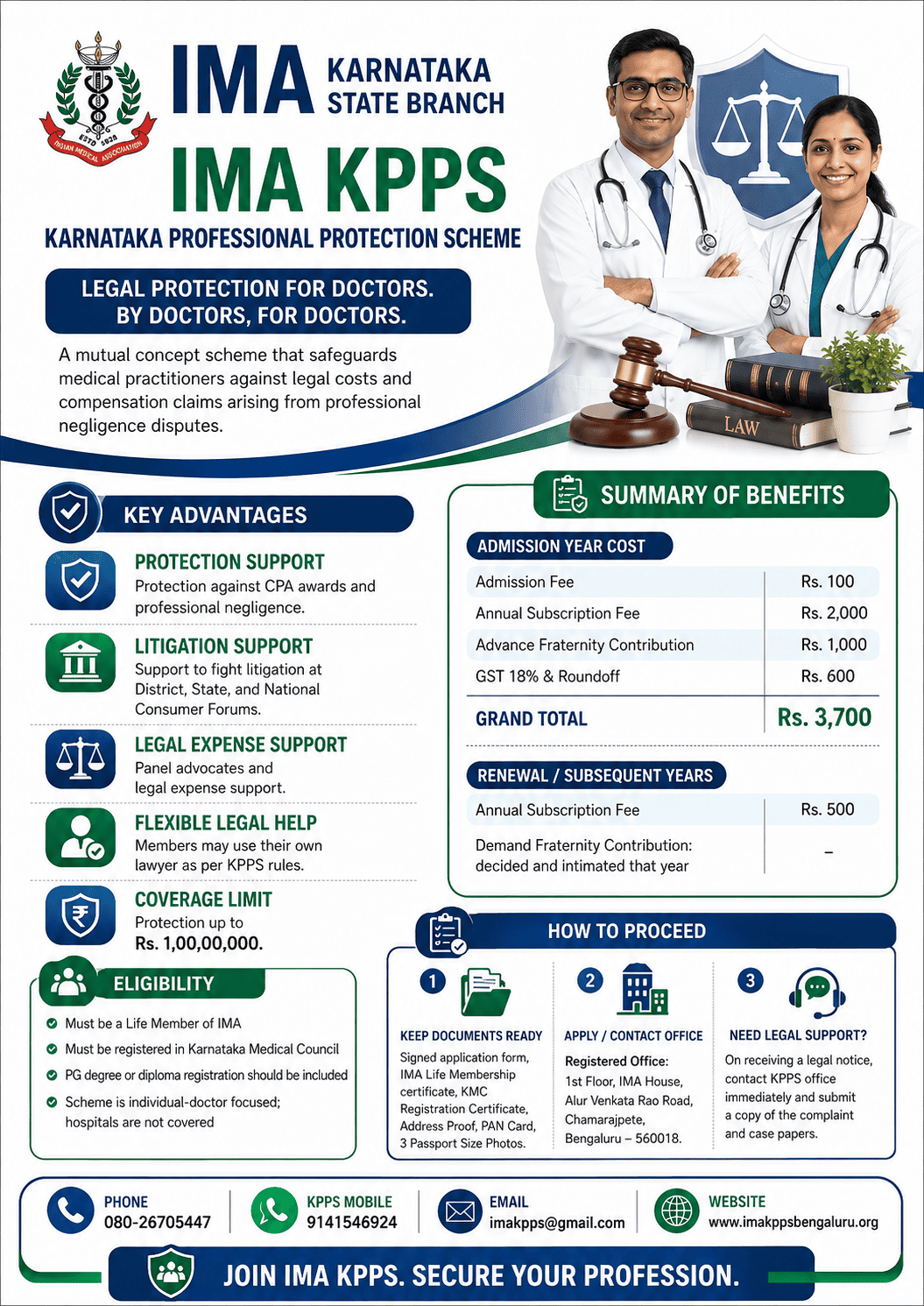
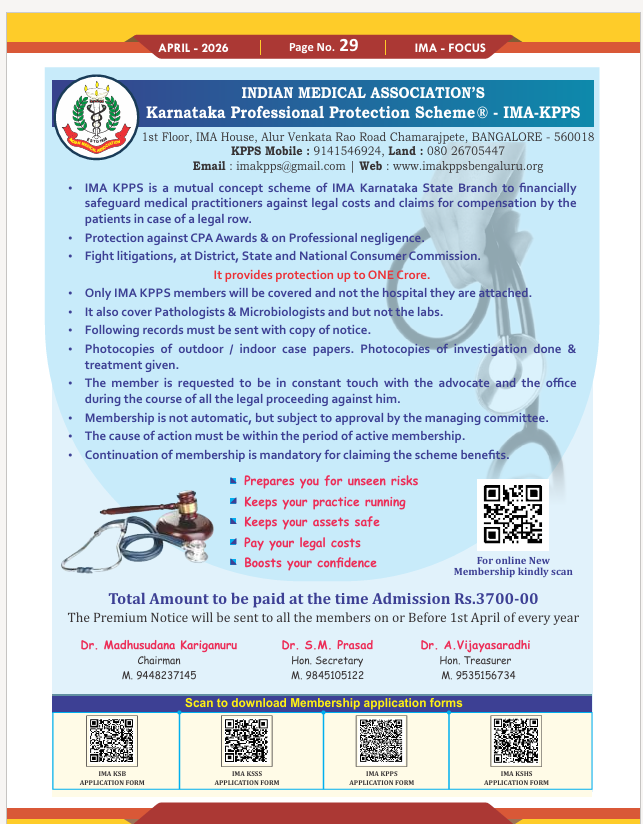
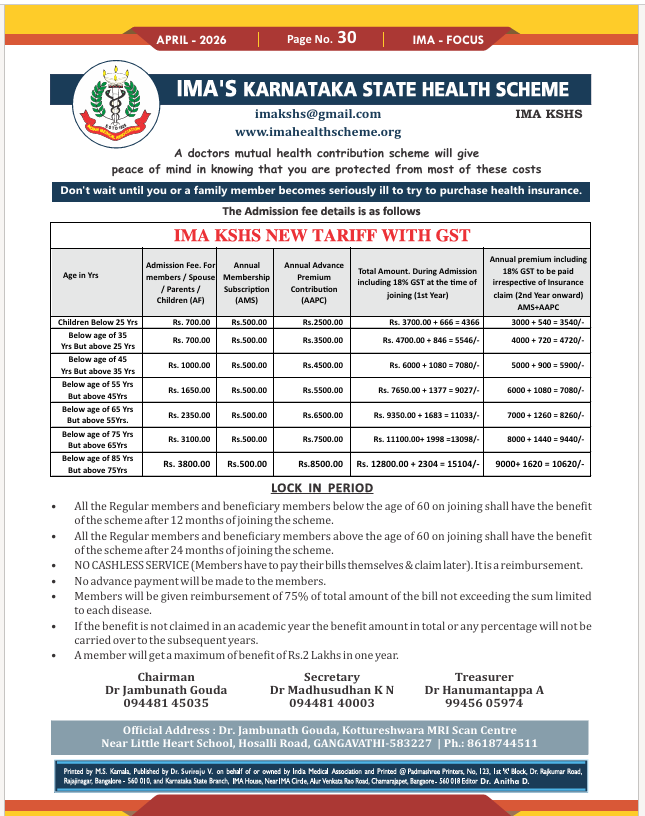
    🏥 KPPS – Professional Protection up to ₹1 Crore
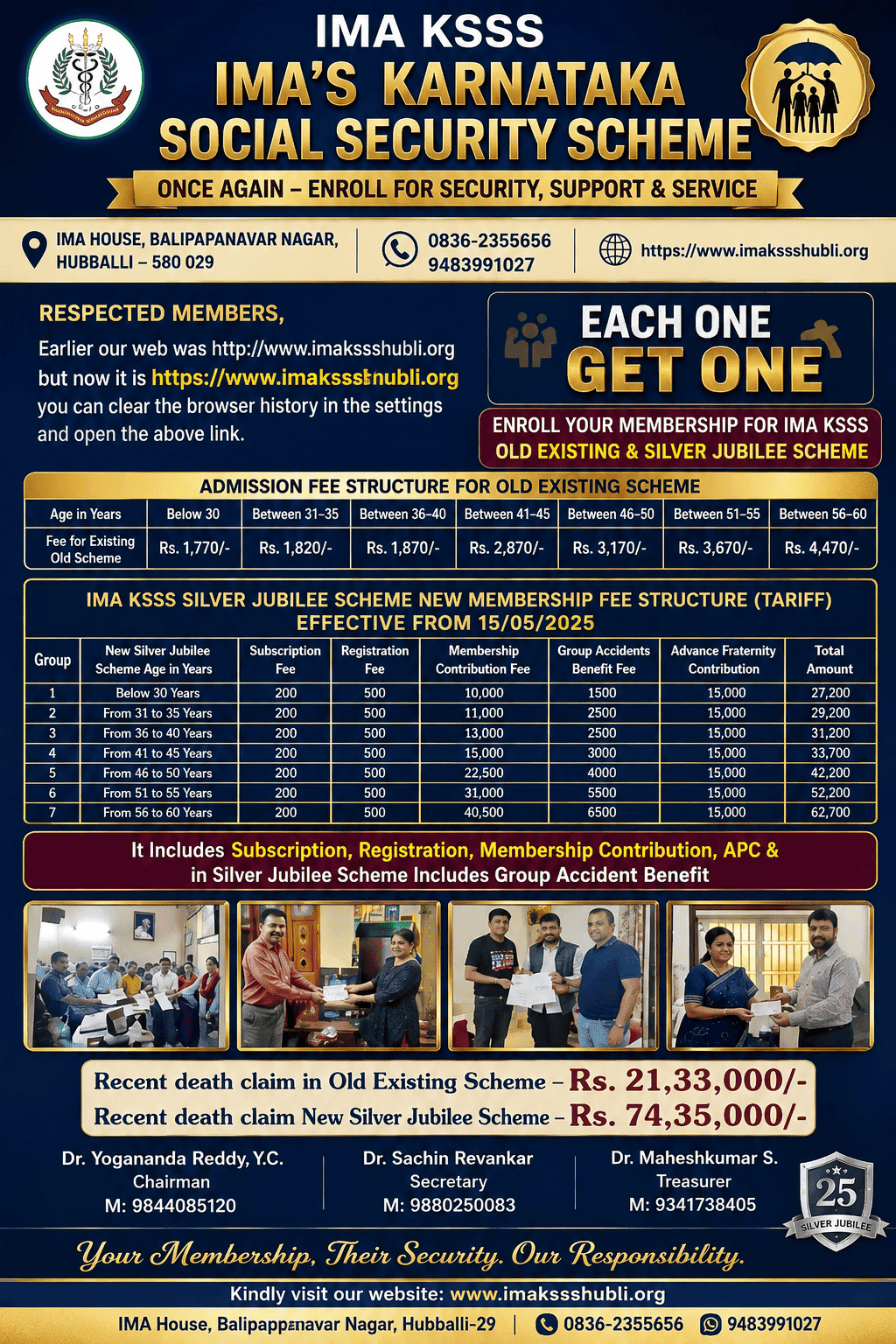
    👨‍👩‍👧 KSSS – Family Benefits up to ₹90 Lakhs
    ❤️ KSHS – Health Benefits up to ₹2 Lakhs
    👉 Among the best protection schemes in India

    📄 DOCUMENTS REQUIRED
    Application Form
    Passport Photo
    Aadhaar Card
    KMC Certificate

    📢 WHO CAN JOIN?
    👨‍⚕️ All Registered Doctors
    🎓 Interns & Postgraduates

    ⚡ CALL TO ACTION
    👉 This is not just membership
    👉 This is collective strength of doctors
    🔴 LAST DATE: 30th April 2026


  • IMA WEBINAR ON – *INFORMED CONSENT* 9pm on 17-04-2026 Friday
    Admin IMA HubA Admin IMA Hub

    2644901.jpg
    *📅 IMA Webinar Event – Informed Consent
    Title:
    IMA Webinar – Informed Consent

    Save this reminder 👇https://calendar.app.google/madj8RxfEVQHH1wP6

    Join Link:
    https://imahbihub.hospigrow.com/post/50⁠�
    Description:
    Join this important IMA HBI webinar focused on “Informed Consent” — a critical medico-legal and ethical aspect of hospital practice.
    👨‍⚕️ Key Takeaways:
    Legal importance of informed consent
    Documentation best practices
    Common mistakes hospitals must avoid
    Real-life case discussions
    🎯 Ideal for:
    Hospital Owners | Doctors | Administrators | Legal Teams

    Please share in your Groups* IMA KSB PUBLIC HEALTH FORUM INVITES YOU TO ATTEND A WEBINAR ON TOPIC – INFORMED CONSENT Time: 9pm Date: 17-04-2026 Friday.

    Zoom Link:
    https://us06web.zoom.us/j/4772160084?pwd=3qSGlgTbt5GSCdnbullOYDLPCnnaz1.1

    Meeting ID: 477 216 0084 Passcode: imaksb

    Youtube: https://youtube.com/live/OeCIbHhQdBU?feature=share

    Regards, Dr. Veerabhadraiah T A President, IMA KSB Dr. Suriraju V Hon. Secretary, IMA KSB. Dr.Pavankumar M Chairman, IMA KSB Public Health Sub Committee.


  • Welcome to IMA Tamil Nadu
    Admin IMA HubA Admin IMA Hub

    Official IMA Tamil Nadu digital platform

Member List

Admin IMA HubA Admin IMA Hub
  • Login

  • Don't have an account? Register

  • First post
    Last post
0
  • Categories
  • Recent
  • Tags
  • Popular
  • Users
  • Groups