
Social Media Misreads Supreme Court Observation on DAMA — IMA-HBI Leaders Forum Clarifies for Doctors
-
Recent observations by the Supreme Court of India regarding Discharge Against Medical Advice (DAMA/LAMA) have been widely misinterpreted on social media, creating confusion among doctors and hospital administrators.
The issue arose while the Court was hearing a case related to end-of-life care and withdrawal of life support in hospitals. During the hearing, the Court noted a common practice observed in many hospitals: when a patient becomes terminally ill or when treatment is considered medically futile, some hospitals ask families to sign a DAMA/LAMA form instead of following formal legal procedures for withdrawal of life support.
However, the Court did not ban DAMA, nor did it introduce criminal penalties for hospitals using it.
Patients and families continue to have the legal right to leave a hospital against medical advice for various reasons such as transfer to another hospital, financial constraints, or personal choice.
The Court’s observation was a caution against misuse of DAMA, particularly in terminal or end-of-life situations. Hospitals are encouraged to follow appropriate medical and legal frameworks, including transparent communication with families, palliative care discussions, and the end-of-life decision-making framework established in the landmark Common Cause v. Union of India judgment.
Clarification by IMA-HBI Leaders Forum
To address the confusion, the Indian Medical Association – Hospital Board of India (IMA-HBI) Leaders Forum reviewed the issue and clarified the following points for the medical fraternity:
• The viral social media posts are misinterpretations of the Court’s observations.
• DAMA remains a legally valid process when a patient or family chooses to leave the hospital against medical advice.
• Doctors cannot be compelled to continue treatment against medical judgment or legal protocols.
• Proper documentation, informed consent, and medico-legal records remain essential while handling DAMA cases.
• In end-of-life situations, hospitals should follow established legal and ethical frameworks rather than using DAMA as a shortcut.Responsible Medical Practice
The key takeaway from the Court’s observation is that DAMA should be used responsibly, ensuring ethical, patient-centered decision-making and adherence to established legal procedures in sensitive cases such as withdrawal of life support.
The IMA-HBI Leaders Forum has urged doctors and hospital administrators not to panic or spread unverified interpretations of the Court’s remarks.
Doctors are encouraged to rely on accurate legal guidance and proper clinical documentation while handling DAMA situations.
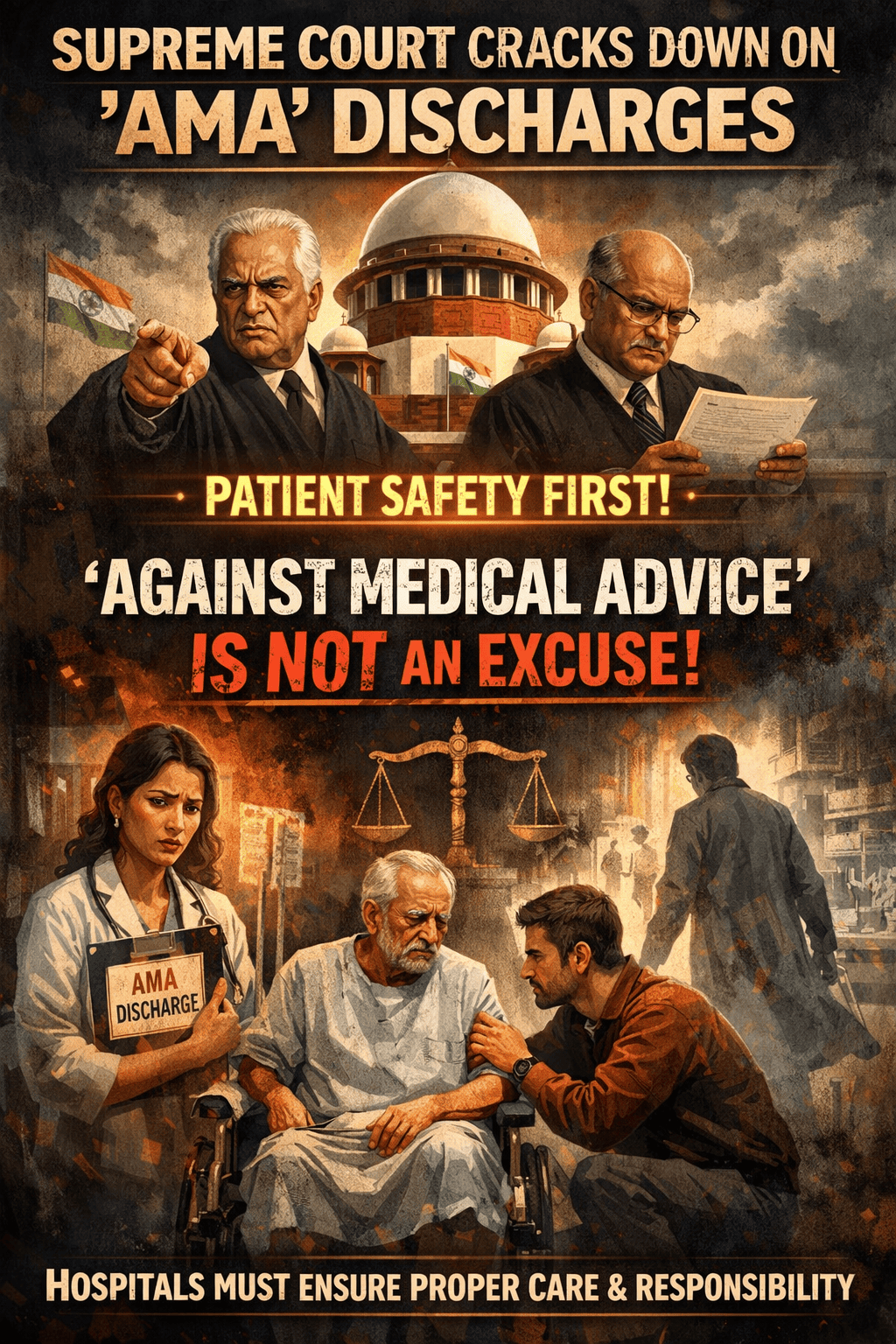
-
Court expects even if patient going Discharge AMA we need to guide them for further treatment and prepare and keep medical documents for future presentation especially in case of MLC cases.
-
“Social Media Misreads Court Order on DAMA — IMA HBI Leaders Forum Brings Clarity for Doctors”
Clarification on DAMA / LAMA Misinterpretation
Recent discussions on social media have created confusion regarding Discharge Against Medical Advice (DAMA/LAMA) after observations made by the Supreme Court of India.
The Court has not banned DAMA, nor has it stated that hospitals or doctors will be criminally liable for every DAMA discharge. Patients and families still have the legal right to leave a hospital against medical advice due to personal choice, financial reasons, or transfer to another facility.
What the Court emphasized is that DAMA should not be misused as a routine shortcut, especially in terminal or end-of-life situations. In such cases, hospitals should follow proper medical and legal procedures under the framework laid down in Common Cause v. Union of India and reaffirmed in the recent judgment Harish Rana v. Union of India, which discusses withdrawal or withholding of life-sustaining treatment through a structured medical decision-making process.
In simple terms:
DAMA remains legally valid, but hospitals must ensure ethical practice, transparent communication with families, and proper end-of-life care protocols instead of using DAMA as a substitute for medical decision-making.Here is a copy of court verdict
SC judgment on Passive Euthanasia Harish Rana vs Union of India Misc application 2238 of 2025 judgment dated 11 March 2026.pdf -
@EditorialTeam
✅ Key Points Doctors Should Know• The circulating social media messages are misinterpretations of the court observations.
• Doctors cannot be forced to treat against medical judgment or legal protocols.
• Proper documentation and informed consent during DAMA remains the safest practice.
• Hospitals must continue following standard medico-legal documentation procedures. -
Clarification on DAMA / LAMA Misinterpretation on SOCIAL MEDIA about supreme court guidance
Recent discussions on social media have created confusion regarding Discharge Against Medical Advice (DAMA/LAMA) after observations made by the Supreme Court of India.
The Court has not banned DAMA, nor has it stated that hospitals or doctors will be criminally liable for every DAMA discharge. Patients and families still have the legal right to leave a hospital against medical advice due to personal choice, financial reasons, or transfer to another facility.
What the Court emphasized is that DAMA should not be misused as a routine shortcut, especially in terminal or end-of-life situations. In such cases, hospitals should follow proper medical and legal procedures under the framework laid down in Common Cause v. Union of India and reaffirmed in the recent judgment Harish Rana v. Union of India, which discusses withdrawal or withholding of life-sustaining treatment through a structured medical decision-making process.
In simple terms:
DAMA remains legally valid, but hospitals must ensure ethical practice, transparent communication with families, and proper end-of-life care protocols instead of using DAMA as a substitute for medical decision-making. -
 A Admin IMA Hub moved this topic from ⚖️ MEDICO-LEGAL DEFENSE HUB on