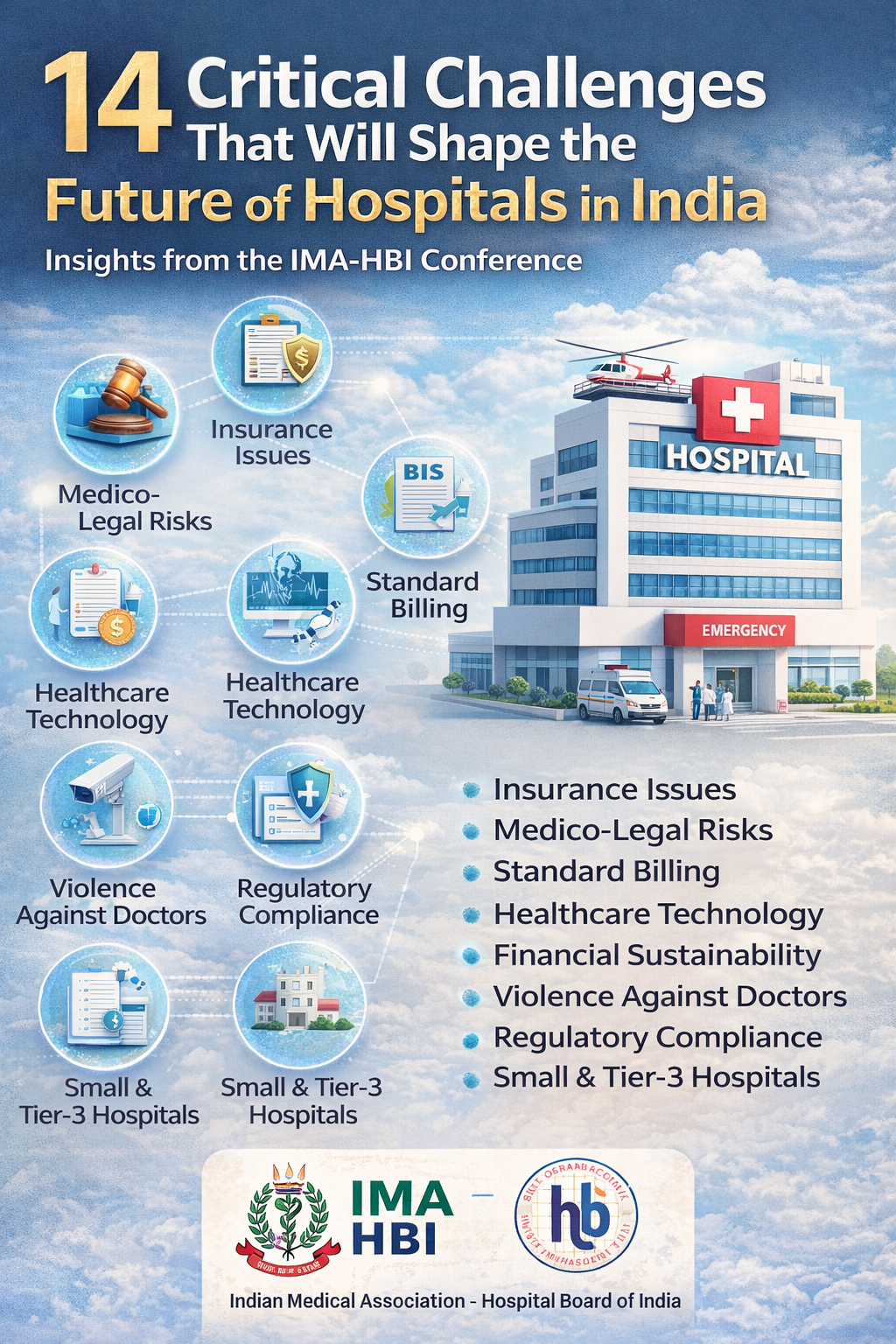
The Future Challenges of Hospitals in India Key Issues Highlighted at the IMA-HBI Conference
-
Healthcare in India is undergoing rapid transformation. Hospitals today are not only centers of clinical care but also institutions that must navigate complex regulations, legal risks, insurance systems, financial pressures, and technological changes.
The recent conference organized by the Indian Medical Association – Hospital Board of India (IMA-HBI) brought together hospital leaders, administrators, and policy experts to discuss the major challenges that will shape the future of hospitals in India.
The topics covered in the conference reflect the realities hospitals are facing today and the issues that will define the healthcare landscape in the coming decade.
- Standardization of Hospital Billing (BIS Format)
One of the important discussions focused on the uniform billing format proposed by the Bureau of Indian Standards (BIS).
Hospital billing across India currently varies widely, making it difficult for patients, insurers, and regulators to interpret hospital charges.
Why this matters for hospitals
Hospitals may soon be required to adopt standardized billing formats.
Billing transparency will increase scrutiny of hospital pricing.
Insurance claim processing may become more structured.
Future concern
Hospitals will need better financial systems, digital billing software, and compliance with standardized billing frameworks.
- Emergency Triage and Patient Prioritization
Emergency departments are the most legally sensitive areas in hospitals. Triage systems help medical teams prioritize patients based on the severity of their condition.
Key challenges
Overcrowded emergency departments
Lack of trained triage staff
Legal expectations of immediate treatment
Why hospitals must focus on this
Poor triage documentation can lead to medical negligence claims or legal complications.
Hospitals must strengthen emergency protocols, training programs, and documentation systems.
- Expired Drugs and Antimicrobial Resistance (AMR)
Medication safety and antibiotic misuse are growing global healthcare concerns.
Expired Drugs
Hospitals must ensure strict inventory monitoring and safe disposal of expired medicines. Using expired drugs can lead to legal liability and patient safety risks.
Antimicrobial Resistance
Overuse of antibiotics in hospitals contributes to drug-resistant infections.
Why this matters
Hospitals will increasingly be required to implement antibiotic stewardship programs and pharmacy audits to control antimicrobial resistance.
- PCPNDT and POCSO Compliance
Hospitals must comply with strict legal frameworks related to prenatal diagnostics and protection of minors.
PCPNDT Act
The Pre-Conception and Pre-Natal Diagnostic Techniques Act regulates ultrasound and prenatal diagnostic services to prevent sex determination.
Hospitals must maintain:
Proper Form-F documentation
Machine registration
Regular record maintenance
POCSO Protocol
The Protection of Children from Sexual Offences Act requires hospitals to follow strict medico-legal procedures while treating minors involved in sexual offences.
Future concern
Failure to comply can result in criminal cases, suspension of licenses, or sealing of equipment.
- The Medico-Legal Triangle
The medico-legal triangle represents the interaction between:
Doctors
Patients
Legal system
With rising awareness and legal activism, hospitals face increasing medico-legal scrutiny.
Key risk areas
Informed consent
Medical documentation
Communication with families
Treatment outcomes
Hospitals must develop strong medico-legal policies and documentation practices.
- Consumer Protection Act and Medical Litigation
Medical services in India fall under consumer protection law, allowing patients to file cases for alleged negligence.
Key concerns
Rising compensation claims
Legal harassment of doctors
Defensive medical practices
Hospitals must strengthen legal awareness, patient communication, and risk management systems.
- Health Insurance Challenges
Insurance systems play a major role in modern healthcare but also create operational challenges.
Key issues faced by hospitals
Low package rates
Delayed claim payments
Claim deductions
TPA administrative burdens
Future concern
Without reforms, hospitals may struggle to maintain financial sustainability while providing quality care.
- Clinical Establishments Act (CEA)
The Clinical Establishments Act aims to standardize healthcare infrastructure and services.
Compliance requirements
Hospital registration
Infrastructure standards
Staff qualifications
Clinical protocols
Concern for hospitals
Small hospitals may face high compliance costs and administrative burdens.
- Umbrella Policy for Small and Medium Hospitals
Smaller hospitals face higher risk from legal cases, disasters, and financial uncertainties.
Umbrella insurance policies can help by covering:
Medico-legal liability
Fire and disaster risks
Institutional legal protection
This is especially important for tier-2 and tier-3 city hospitals.
- Violence Against Doctors and Hospitals
Violence against healthcare workers has become a serious issue in India.
Hospitals must strengthen:
Security systems
Communication with families
Crisis management protocols
Protection laws and hospital policies are essential to ensure safe working environments for doctors.
- Universal Health Coverage (UHC)
Universal Health Coverage aims to ensure that every citizen has access to affordable healthcare services.
Impact on hospitals
Hospitals will play a major role in delivering care under government schemes.
However, concerns remain about:
Reimbursement rates
Administrative processes
Infrastructure requirements
- Survival of Hospitals in Tier-3 Cities
Hospitals in smaller cities face unique challenges:
Limited patient volume
Low insurance penetration
Lack of specialist doctors
Financial sustainability
Policy support and innovative healthcare models are needed to strengthen rural and semi-urban healthcare infrastructure.
- Technology Adoption and AI in Hospitals
Healthcare is entering a digital era.
Hospitals are increasingly adopting:
Artificial intelligence
Electronic medical records
Telemedicine
Hospital management software
Technology will improve efficiency but also requires investment, training, and cybersecurity measures.
- Medical Entrepreneurship and Healthcare Investment
Healthcare is also becoming an important sector for entrepreneurship and investment.
Foreign direct investment and healthcare startups are reshaping the healthcare ecosystem.
Hospitals must adapt to new business models, digital platforms, and competitive healthcare markets.
Conclusion: Why These Issues Matter for the Future of Hospitals
The topics discussed in the IMA-HBI conference highlight a clear reality:
Running a hospital in the future will require expertise in medicine, management, law, finance, and technology.
Hospitals must prepare for:
Increasing regulatory oversight
Rising medico-legal risks
Changing insurance systems
Technological transformation
Financial sustainability challenges
Platforms like IMA-HBI are essential to bring hospitals together, advocate for policy reforms, and support healthcare institutions in navigating these complex challenges.
The future of healthcare in India will depend on how effectively hospitals address these issues today.