CCI Closes Decade-Long Case Against 12 Delhi-NCR Hospitals — No Abuse of Dominance Found
-
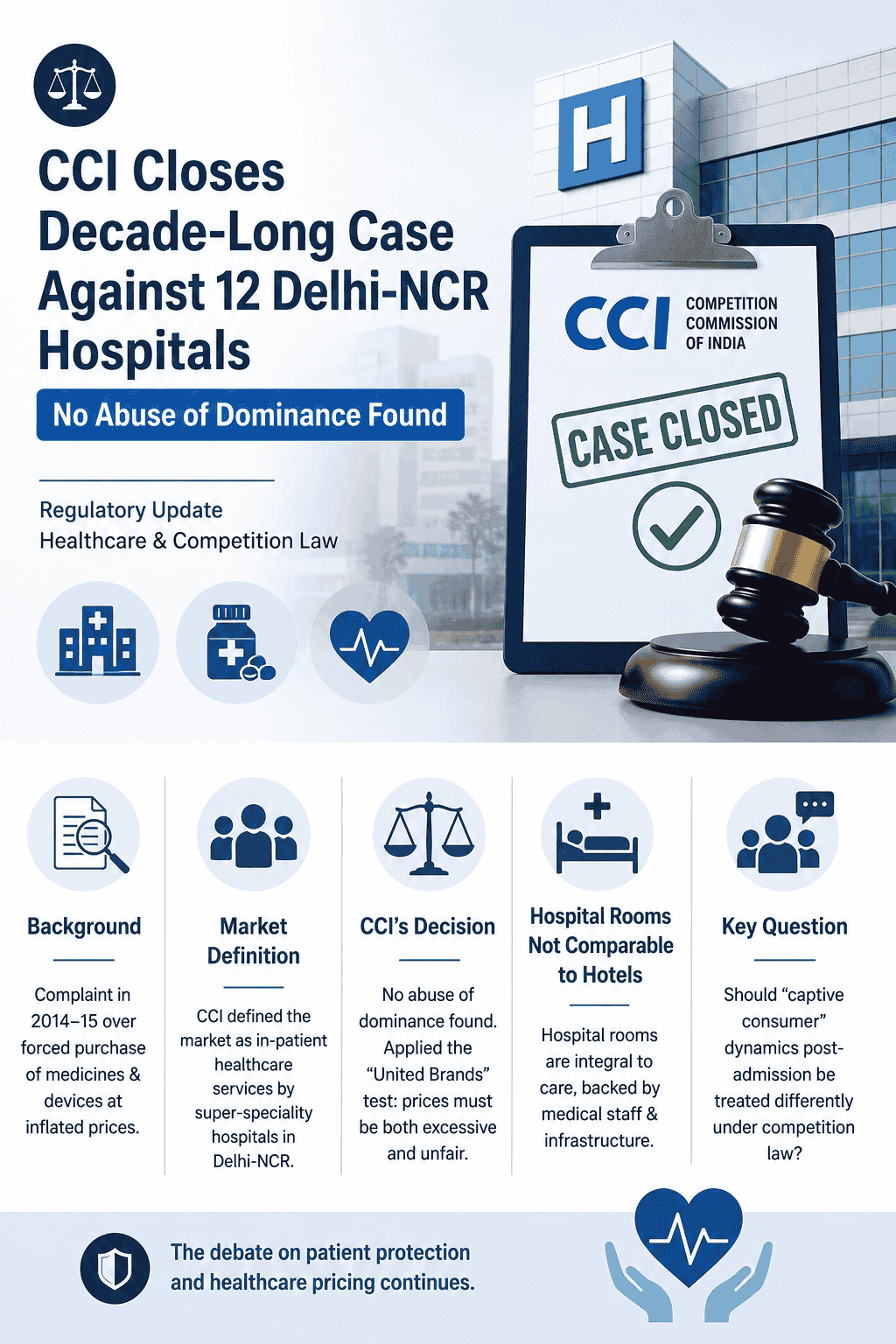
In a landmark ruling dated May 21, 2025, the Competition Commission of India (CCI) has officially closed abuse of dominance proceedings against 12 major super-speciality hospitals in the Delhi-NCR region, bringing an end to a nearly 10-year investigation.
The hospitals include Max Super Specialty Hospital (Patparganj, Saket, Shalimar Bagh), BLK Max Super Specialty Hospital, Fortis Flt. Lt. Rajan Dhall Hospital, Fortis Escorts Institute and Research Centre, Sir Ganga Ram Hospital, Indraprastha Apollo Hospital, St. Stephen's Hospital, and Batra Hospital & Medical Research Centre, among others. Devdiscourse
📋 Background
The case originated from a complaint filed in 2014–15 alleging that these hospitals were exploiting their dominant positions by forcing patients to purchase medicines, consumables, and medical devices from in-house pharmacies at prices several times higher than open-market rates. PNI
The CCI initially ordered an investigation. The Director General (DG) examined all 12 hospitals and concluded they were dominant — but the Commission ultimately disagreed with those findings. Bar and Bench⚖️ What the CCI Decided
The CCI defined the relevant market as the provision of in-patient healthcare services by super-speciality hospitals across the Delhi-NCR region — not each individual hospital as a separate market. India Legal
The Commission also observed that medicines, consumables, and medical devices form part of bundled hospital treatment and are not purchased by patients as standalone products. India Legal
On pricing, the CCI applied the two-stage "United Brands" test — requiring proof that prices were both excessive and unfair — and found that the DG had incorrectly treated excessive pricing as automatically unfair, which is an insufficient legal standard. Devdiscourse
The CCI also rejected comparisons between hospital rooms and hotel rooms, noting that hospital rooms are integral to clinical infrastructure supported by medical staff, emergency systems, and continuous patient monitoring. India Legal💬 Why This Is Controversial
Not everyone agrees with the outcome. Critics argue the ruling raises a fundamental question: once a patient is admitted, do they remain a patient — or become a captive customer? Before admission, a patient may theoretically be in a competitive market, but after admission, the hospital controls their care environment entirely. Telangana Today
The CCI appears to have accepted that admitted patients rely on internal hospital ecosystems, yet concluded this does not constitute actionable abuse under competition law. Telangana Today🔍 Key Takeaways for Discussion
Should "captive consumer" dynamics post-admission be treated differently under competition law?
Is the two-stage excessive + unfair pricing test adequate to protect patients?
Does defining the market broadly (all Delhi-NCR super-speciality hospitals) undermine patient protection in practice?
What regulatory mechanisms beyond competition law can address hospital pricing transparency?📌 Source: ETHealthworld / Economic Times | Bar & Bench | India Legal Live
Drop your thoughts below — is this a win for the healthcare sector, or a gap in patient protection law?