
The Government’s Rate Standardisation Directive: Pragmatic Reform or Blunt Instrument?
-
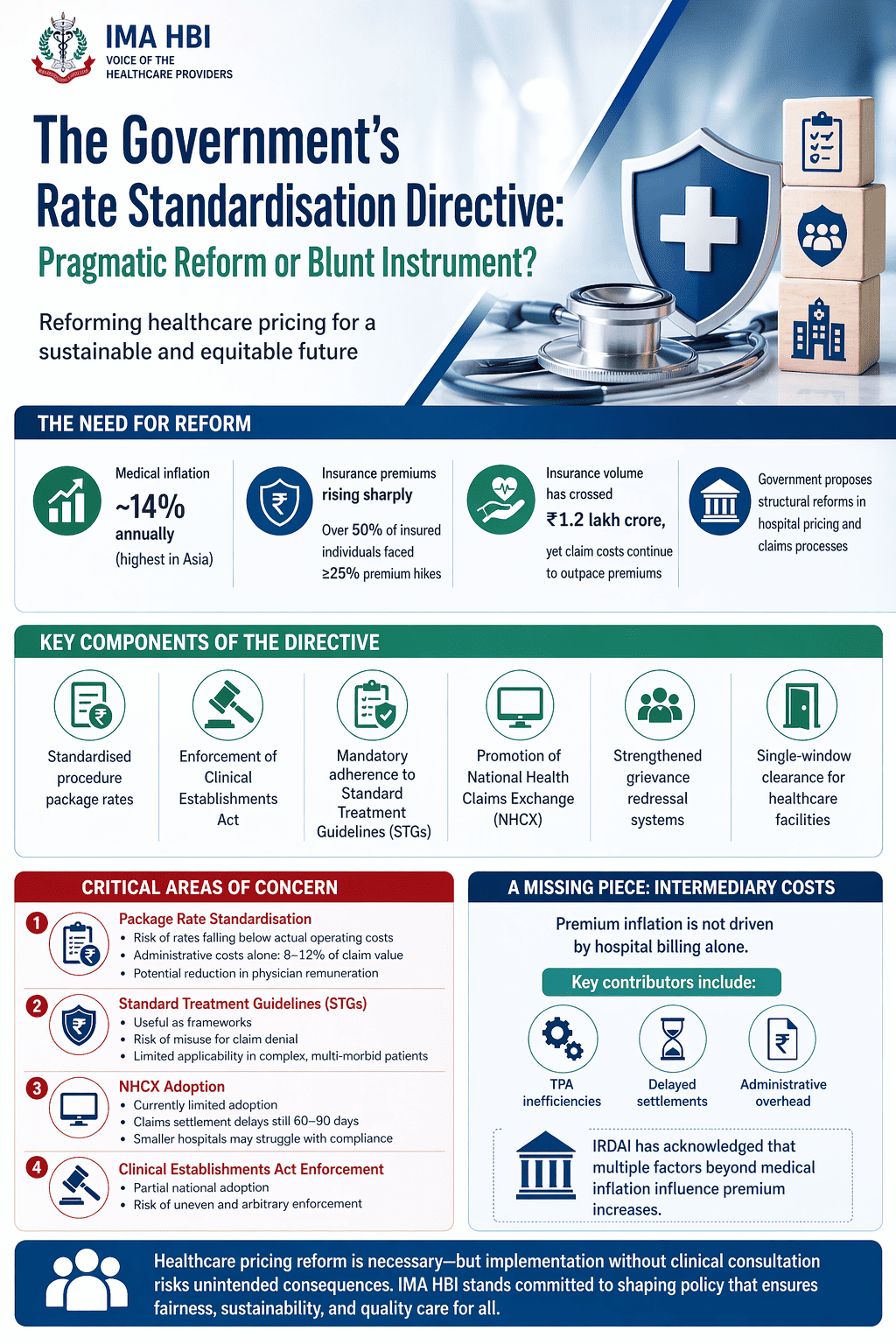
India’s healthcare system is facing sustained financial pressure:Medical inflation: ~14% annually (highest in Asia)
Insurance premiums rising sharply
Over 50% of insured individuals faced ≥25% premium hikesInsurance volume has crossed ₹1.2 lakh crore, yet claim costs continue to outpace premiums.
In response, the government has proposed structural reforms in hospital pricing and claims processes.
Key Components of the Directive
- Standardised procedure package rates
- Enforcement of Clinical Establishments Act
- Mandatory adherence to Standard Treatment Guidelines (STGs)
- Promotion of National Health Claims Exchange (NHCX)
- Strengthened grievance redressal systems
- Single-window clearance for healthcare facilities
Critical Areas of Concern
-
Package Rate Standardisation
Risk of rates falling below actual operating costs
Administrative costs alone: 8–12% of claim value
Potential reduction in physician remuneration -
Standard Treatment Guidelines (STGs)
Useful as frameworks
Risk of misuse for claim denial
Limited applicability in complex, multi-morbid patients -
NHCX Adoption
Currently limited adoption
Claims settlement delays still 60–90 days
Smaller hospitals may struggle with compliance -
Clinical Establishments Act Enforcement
Partial national adoption
Risk of uneven and arbitrary enforcement
A Missing Piece: Intermediary Costs
Premium inflation is not driven by hospital billing alone.
Key contributors include:
- TPA inefficiencies
- Delayed settlements
- Administrative overhead
IRDAI has acknowledged that multiple factors beyond medical inflation influence premium increases.
Discussion Questions for the Forum
Q1. Were you involved in rate standardisation consultations? Was clinical input considered?
Q2. Have STGs supported or restricted your clinical decision-making?
Q3. Should IMA HBI submit a formal policy position to the Ministry?
Q4. Is NHCX ready for large-scale implementation?
Q5. Should regulatory focus extend equally to insurer and TPA inefficiencies?
Healthcare pricing reform is necessary—but implementation without clinical consultation risks unintended consequences.
If reforms shift cost burdens onto frontline providers without addressing systemic inefficiencies, the core problem remains unresolved.
IMA HBI has both the authority and responsibility to shape this policy direction.
Let this forum serve as the foundation for a structured, evidence-based position.