Handling FIRs Against Doctors in India -A Comprehensive Medico-Legal Survival Guide for Doctors, Hospitals & Healthcare Institutions
-
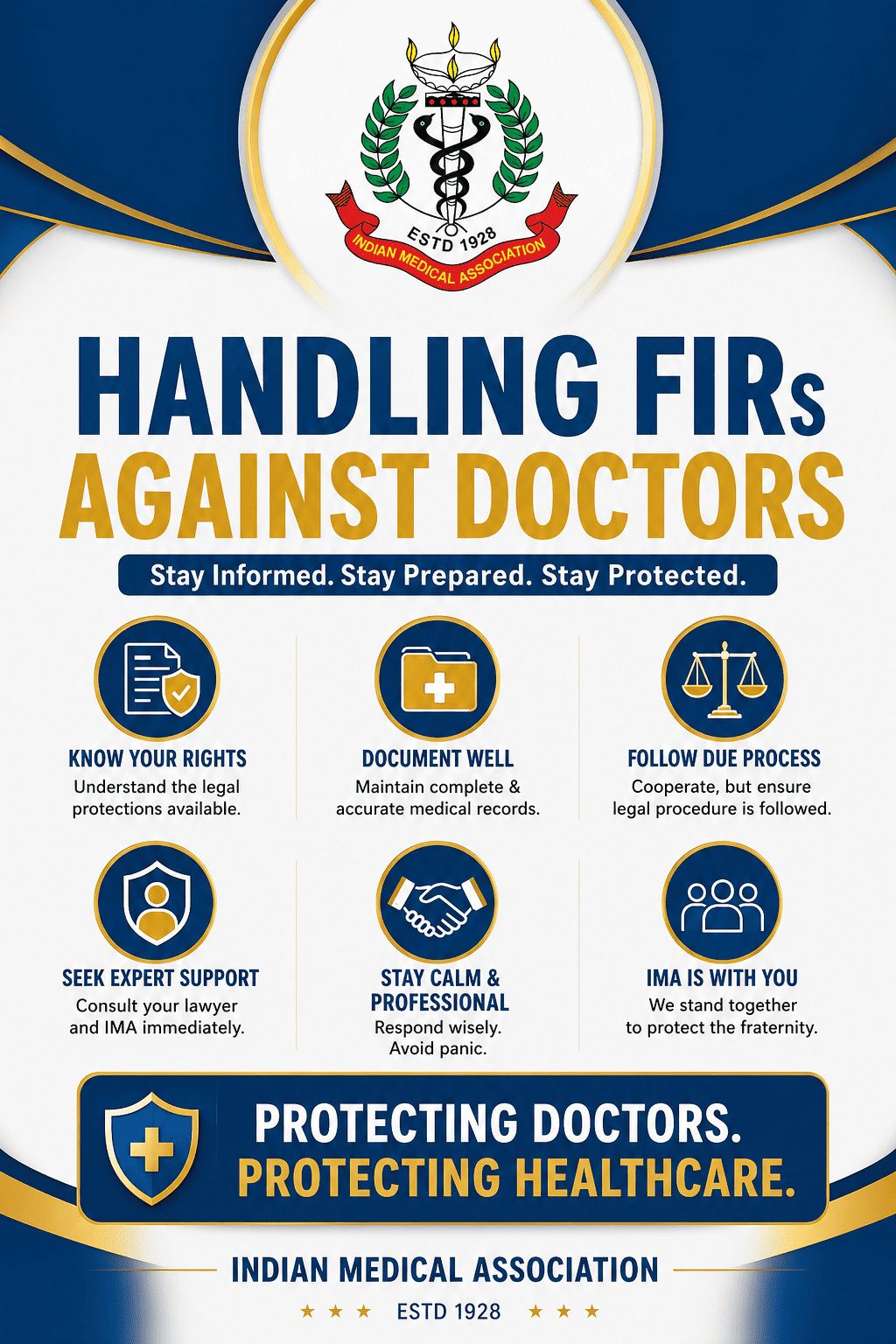
Why This Is Critically Important
The medico-legal environment in India has become significantly more aggressive, procedurally complex, and legally sensitive after the implementation of the new criminal laws on 1 July 2024.
Doctors today face:
- Increasing criminal FIRs after adverse outcomes
- Rising public expectations
- Social media pressure
- Police intervention in hospital disputes
- Criminalization of clinical judgment
- Aggressive litigation culture
- Increased medico-legal scrutiny under BNS Section 106
Recent developments during 2025–2026 show:
- Increased FIR registration against doctors under BNS §106(1)
- Growing debate regarding mandatory imprisonment provisions
- Expanded interpretation of “gross negligence”
- Continued judicial reliance on Jacob Mathew safeguards
- Greater emphasis on expert medical board review before prosecution
Recent medico-legal discussions and academic legal reviews in 2026 continue to reaffirm that:
Criminal liability against doctors can arise only in cases of “gross,” “reckless,” or “egregious” negligence — not for mere error of judgment or unsuccessful outcomes. ([The Academic][1])
PART 1 – The Current Legal Position.
1.1 BNS Section 106(1) – The Core Provision Affecting Doctors
The most important criminal provision affecting medical practitioners today is:
Section 106(1) – Bharatiya Nyaya Sanhita, 2023
This section replaced:
- IPC Section 304A
and deals with:
“Causing death by rash or negligent act not amounting to culpable homicide.”
Key Changes Introduced Under BNS
Aspect Old IPC §304A New BNS §106(1) Maximum punishment Up to 2 years Up to 5 years (general cases) Punishment for doctors No separate category Separate category for Registered Medical Practitioners Doctors’ punishment ceiling Same as public Up to 2 years Fine Optional Mandatory with imprisonment Nature of punishment OR fine OR imprisonment Imprisonment AND fine
Most Significant Concern for Doctors.
Under IPC 304A:
Courts could impose only a fine without imprisonment.
Under BNS Section 106:
Imprisonment plus fine becomes mandatory upon conviction.
This change has become one of the largest concerns raised by the medical fraternity nationwide. ([National Law School of India University][2])
The Indian Medical Association has repeatedly argued that:
- absence of criminal intent (mens rea)
- honest professional judgment
- emergency decision-making
- and inherent clinical uncertainty
must not be criminalized.
1.2 Definition of “Registered Medical Practitioner”
The legal interpretation clarifies that reduced punishment protection applies only to:
-
Doctors recognized under the National Medical Commission Act, 2019
-
Doctors whose names are entered in:
- National Medical Register
- State Medical Register
This means:
Unregistered practitioners cannot claim the reduced protection available under BNS §106(1). ([Judex Tutorials][3])
PART 2 – The Jacob Mathew Judgment Still Governs Everything
Jacob Mathew v. State of Punjab (2005)
Even in 2026, the single most important protection for doctors remains:
Jacob Mathew v. State of Punjab
(2005) 6 SCC 1
The Supreme Court clearly held:
Criminal negligence requires a very high degree of negligence — far beyond ordinary carelessness.
Core Principles Still Applicable in 2026
1. Expert Medical Opinion Is Mandatory
Before prosecuting a doctor:
- a competent medical opinion
- from an independent qualified doctor
- preferably government service
- in the same specialty
must be obtained.
2. Routine Arrest of Doctors Is Discouraged
The Supreme Court clearly stated:
Doctors should not be arrested routinely merely because an FIR has been registered.
Arrest should occur only if:
- required for investigation,
- evidence collection,
- or risk of absconding exists.
3. Mere Adverse Outcome ≠ Criminal Negligence
Courts continue to reiterate:
- complication ≠ negligence
- death ≠ criminality
- failed treatment ≠ gross negligence
The prosecution must establish:
reckless disregard for patient safety.
([The Academic][1])
PART 3 – The 2026 Debate Around Preliminary Enquiry
One major legal concern emerging after implementation of BNSS is:
Whether police can directly register FIRs without preliminary medical scrutiny.
Legal scholars in 2025–2026 have warned that:
- procedural safeguards under Jacob Mathew
- and Lalita Kumari judgments
may weaken if police bypass preliminary enquiry mechanisms under the new procedural framework. ([National Law School of India University][2])
This has become one of the biggest medico-legal concerns for doctors in India today.
PART 4 – The Bolam Test Remains the Strongest Defence
The Supreme Court continues to rely heavily upon the:
Bolam Test
which states:
A doctor is not negligent if acting according to a responsible body of medical opinion.
This remains the foundational defence in:
- criminal cases
- consumer cases
- civil negligence matters
- disciplinary proceedings
Even today, courts continue emphasizing:
Medicine is not an exact science.
Different treatment approaches do not automatically amount to negligence. ([The Academic][1])
PART 5 – Immediate Action Steps if FIR Is Filed Against a Doctor
Step 1 – Stay Calm and Do Not Abscond
The first few hours after:
- death,
- complication,
- violence,
- FIR registration,
- media escalation
are extremely critical.
Never:
- flee the hospital
- switch off phone
- hide records
- make emotional statements
Step 2 – Preserve All Medical Records Immediately
Secure:
- Case sheets
- OPD notes
- Consent forms
- OT records
- ICU charts
- Drug charts
- Vitals
- Nursing records
- Imaging reports
- Lab reports
- Death summary
- Referral notes
Important:
Never alter records after the incident.
Tampering itself can become:
- separate criminal evidence,
- and severely damage defence credibility.
Step 3 – Secure CCTV Footage Immediately
One of the most common mistakes in hospitals:
CCTV footage gets overwritten within 24–72 hours.
Immediately preserve:
- ICU footage
- casualty footage
- OT corridor footage
- billing counters
- aggression incidents
- mob violence evidence
Step 4 – Contact Lawyer + IMA Immediately
Doctors should immediately:
- contact criminal defence counsel,
- notify indemnity insurer,
- inform hospital administration,
- contact State Indian Medical Association medico-legal support system.
Step 5 – Verify FIR Sections Carefully
Wrong registration under:
- BNS §101/102
(old culpable homicide provisions)
can create severe legal consequences.
Most medical negligence allegations should ordinarily fall under:
BNS §106(1)
which remains bailable.
Step 6 – Apply for Anticipatory Bail
Under BNSS provisions:
- anticipatory bail remains available,
- especially where arrest appears unnecessary.
Courts continue to protect doctors where:
- cooperation exists,
- records are preserved,
- expert opinion is pending.
PART 6 – Important Legal Protections Available
BNS Section 26 – Good Faith Protection
Equivalent to old IPC Section 88.
Protects acts done:
- in good faith,
- for patient benefit,
- with due care,
- with consent.
This remains a critical defence for doctors acting during:
- emergencies,
- ICU situations,
- life-saving interventions,
- high-risk procedures.
BNSS Section 528 – Quashing of FIR
High Courts can quash FIRs where:
- no prima facie negligence exists,
- no causal link exists,
- prosecution is abusive,
- or expert opinion is absent.
Recent High Court decisions continue relying heavily on:
- Jacob Mathew,
- Bolam principles,
- and gross negligence threshold tests.
PART 7 – Reality: FIRs Against Doctors Are Increasing
Several recent FIRs registered during 2025–2026 under BNS §106(1) have triggered widespread concern in the medical fraternity.
One notable 2026 case involved FIR registration against multiple specialists after a surgery-related death in a private hospital in Amritsar, following constitution of a medical board and SIT investigation. ([The Times of India][4])
These incidents demonstrate:
- rising police intervention,
- growing public pressure,
- and the urgent need for hospitals to establish structured medico-legal crisis systems.
PART 8 – Common Mistakes Doctors Still Make
Mistake Impact Verbal apology May be treated as admission Record alteration Criminal tampering Speaking to police without lawyer Statements used against doctor Delay in securing CCTV Loss of evidence Emotional confrontation with relatives Escalation risk Failure to notify insurer Policy complications Ignoring notices Risk of warrants
PART 9 – Institutional Risk Management Recommendations
Every hospital should now maintain:
Mandatory Medico-Legal Preparedness System
Essential Components
- Medico-legal SOP manual
- FIR response protocol
- Violence response system
- CCTV retention policy
- Documentation audit
- Consent protocol
- Adverse event reporting mechanism
- Media communication protocol
- Legal escalation workflow
- IMA coordination mechanism
PART 10 – Final Strategic Message for Doctors
The Indian legal system in 2026 still recognises an extremely important principle:
Medicine involves uncertainty.
Courts repeatedly continue to hold:
- every death is not negligence,
- every complication is not criminality,
- and every failed treatment is not recklessness.
However:
- poor documentation,
- communication failure,
- altered records,
- and absence of institutional preparedness
can convert even defensible cases into dangerous medico-legal crises.
The strongest protection for doctors today remains:
- ethical practice,
- proper documentation,
- transparent communication,
- institutional systems,
- and immediate legal response.
Important References
- Jacob Mathew v. State of Punjab (2005) 6 SCC 1
- Kusum Sharma v. Batra Hospital (2010) 3 SCC 480
- Dr. Suresh Gupta v. Govt. of NCT Delhi (2004) 6 SCC 422
- Bharatiya Nyaya Sanhita, 2023
- Bharatiya Nagarik Suraksha Sanhita, 2023
- National Crime Records Bureau Reports
- 2026 Academic Reviews on Medical Negligence Law ([The Academic][1])
- National Law School Legal Analysis on BNS Impact ([National Law School of India University][2])
- Recent BNS Section 106 Legal Analysis (2026) ([Judex Tutorials][3])
Disclaimer
This document is intended solely for educational and professional awareness purposes within the Indian Medical Association / HospiGrow professional ecosystem.
It does not constitute formal legal advice.
Doctors facing actual medico-legal proceedings should always consult:
- qualified criminal defence lawyers,
- indemnity advisors,
- and medico-legal experts immediately.