Consent Forms in Hospitals: What Makes Them Legally Valid — and What Puts Hospitals at Risk
-
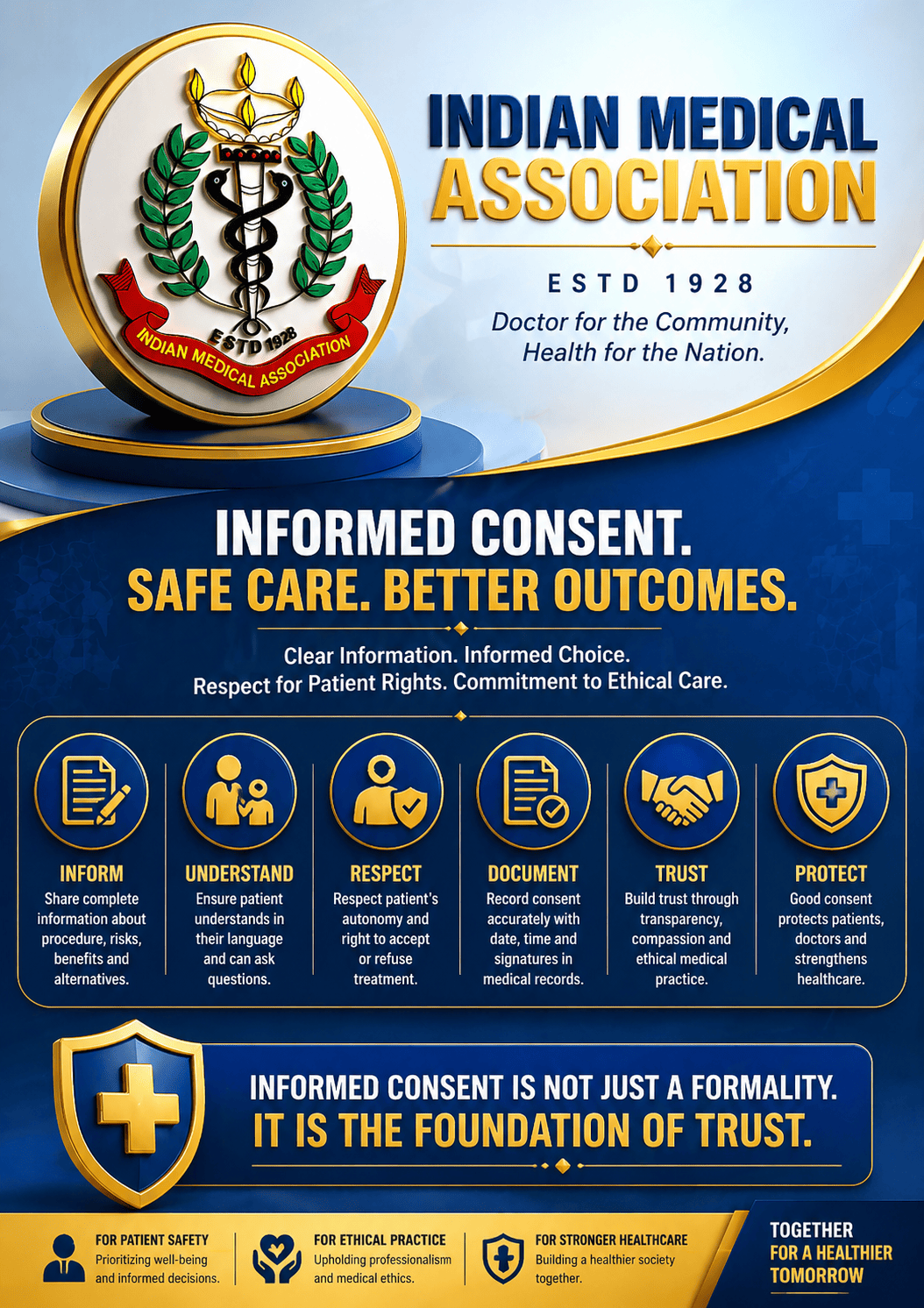
Most hospitals maintain consent forms. However, many still fail to meet the legal standards required for valid informed consent under Indian law. Courts across India have repeatedly clarified that a patient’s signature alone does not protect a doctor or hospital from liability.
Poorly obtained, vague, rushed, or blanket consents have led to significant medico-legal consequences, including negligence findings, compensation orders, and allegations of assault and battery. Every hospital, clinic, and surgical team must therefore understand that informed consent is not merely paperwork — it is a legally accountable clinical process.
The 6 Essential Elements of a Legally Valid Consent
1. Voluntary Consent
Consent must be given freely, without coercion, emotional pressure, intimidation, or inducement. A patient who feels compelled or forced cannot be considered to have given valid consent.
2. Informed Consent
The patient must receive clear information regarding:
- Nature and purpose of the procedure
- Expected benefits
- Common and serious risks
- Possible complications
- Available alternatives
- Consequences of refusing treatment
Without proper disclosure, consent is legally defective.
3. Competent Consent
The person signing must:
- Be above 18 years of age
- Mentally competent
- Conscious and oriented
- Free from sedation, intoxication, or incapacitation
Consent obtained from a sedated or mentally impaired patient may not stand legal scrutiny.
4. Procedure-Specific Consent
Indian courts have consistently rejected “blanket consent” forms. Consent must clearly mention the exact procedure being performed. Statements such as “authorize all treatments deemed necessary” are legally insufficient.
5. Understood Consent
Consent must be explained in a language the patient understands. If the patient cannot understand the language of the form, interpretation must be documented.
6. Proper Documentation
Valid consent should always include:
- Patient signature
- Date and time
- Doctor’s countersignature
- Witness signature where applicable
- Proper filing in medical records
Verbal consent alone is difficult to defend legally in disputed cases.
Key Laws Governing Consent in India
Indian Penal Code – Section 88
A doctor receives legal protection for procedures performed with valid consent. Without proper consent, even a medically appropriate procedure may legally amount to assault.
Consumer Protection Act, 2019
Failure to obtain valid informed consent can be treated as “deficiency in service,” exposing hospitals and doctors to compensation claims before consumer courts.
MCI Regulations, 2002 (Amended 2012)
Performing surgical procedures without proper informed written consent constitutes professional misconduct.
HIV & AIDS (Prevention and Control) Act, 2017
Specific written consent is mandatory before HIV testing. Non-compliance can result in statutory penalties.
NABH Standards
NABH standards mandate institutional consent policies and evaluate both documentation quality and consent process compliance during audits.
Digital Personal Data Protection Act, 2023
As hospitals increasingly adopt EHR and digital systems, patient data consent, storage, and usage now carry additional legal responsibilities under data protection law.
Landmark Judgments Every Hospital Must Know
Samira Kohli vs. Dr. Prabha Manchanda (Supreme Court, 2008)
The Supreme Court held that doctors cannot extend the scope of surgery beyond the consent obtained unless it is immediately life-saving. Procedure-specific consent became a binding legal principle through this judgment.
M. Chinnaiyan vs. Sri Gokulam Hospital
The NCDRC ruled that blood transfusion requires a separate specific consent and cannot be merged into a general surgical consent form.
Dr. Shailesh Shah vs. Aphraim Jayanand Rathod
The court clarified that re-exploration surgery requires fresh consent. Previous surgical consent cannot automatically cover subsequent procedures.
Common Consent Mistakes That Create Legal Exposure
Hospitals frequently face litigation because of preventable consent-related errors, including:
- Blanket or generalized consent forms
- Relative signing despite patient competency
- Consent taken after sedation or pre-medication
- Last-minute consent before surgery
- Failure to explain risks or alternatives
- Missing doctor countersignature
- Alterations after patient signature
- Combined surgical and transfusion consent
- Anaesthesia risks explained by non-anaesthesiologists
- Forms not explained in the patient’s language
Indian courts have repeatedly viewed such deficiencies seriously.
Essential Consent Documentation Checklist
Every valid hospital consent should include:
✔ Patient identification details
✔ Specific procedure name
✔ Purpose of treatment
✔ Risks and complications
✔ Benefits and alternatives
✔ Refusal consequences
✔ Language used for explanation
✔ Opportunity to ask questions
✔ Statement regarding withdrawal rights
✔ No-guarantee clause
✔ Date and time
✔ Doctor signature with registration number
✔ Witness signatures where appropriate
✔ Separate blood transfusion consent
✔ Proper medical record storage
Practical Risk-Reduction Rules for Hospitals
• Never use blanket consent forms
Each procedure requires independent, specific authorization.
• Maintain separate transfusion consent
Blood transfusion carries distinct legal and clinical risks.
• Ensure anaesthesia consent is taken by the anaesthesiologist
This is both clinically and legally important.
• Always mention date and time
Undated forms are weak evidence in litigation.
• Obtain fresh consent for re-exploration surgeries
Prior consent does not automatically continue indefinitely.
• Record the language used
This becomes critical in legal disputes involving comprehension.
• Document patient questioning opportunity
Courts increasingly examine whether true dialogue occurred.
• Use independent witnesses in high-risk procedures
Especially important in major surgeries and critical care cases.
• Preserve records properly
Missing consent documentation is often interpreted adversely in court.
Final Takeaway
Informed consent should never be treated as a routine signature exercise. It is a legally sensitive clinical communication process that directly impacts patient trust, ethical practice, hospital accreditation, and medico-legal protection.
Courts today evaluate not only whether a form was signed — but whether the patient genuinely understood what they were consenting to. The quality of the consent process matters as much as the document itself.