Medico-Legal Cases, Medical Negligence, and the 2026 Supreme Court Ruling on Posthumous Liability — A Working Note for Practising Doctors
-
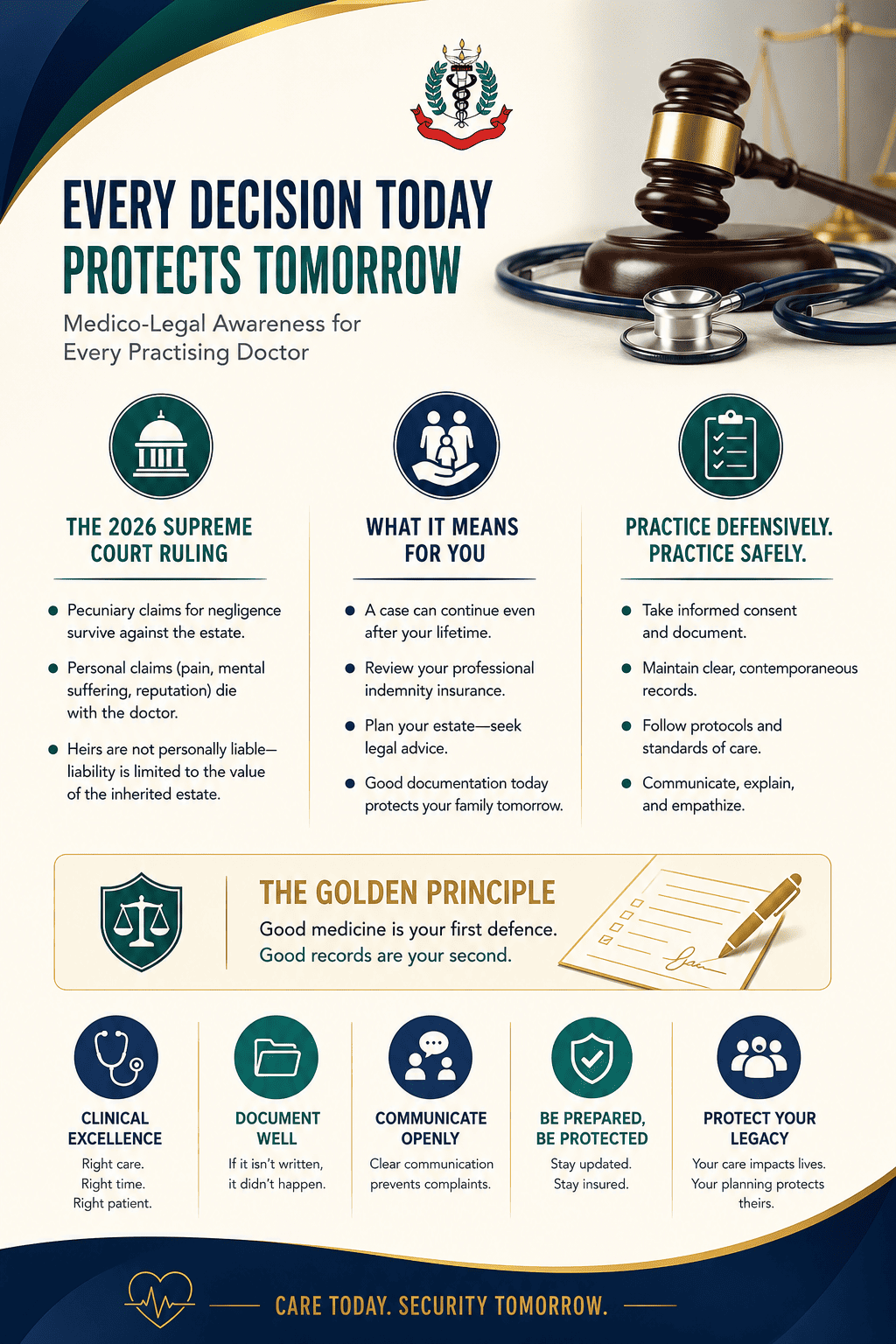
A primer on what a Medico-Legal Case actually is, how to handle one without exposing yourself, the statutory architecture that governs negligence in India, and what the Supreme Court's recent judgment in Kumud Lall changes for every clinician — and their family.
1. The 2026 Ruling, Explained Properly
On 4 May 2026, a Bench of Justices J.K. Maheshwari and Atul S. Chandurkar delivered judgment in Kumud Lall v. Suresh Chandra Roy (Dead) Through LRs, 2026 INSC 443. Most of the social-media coverage has reduced this to a single line — "your family will pay your negligence bills." That framing is incomplete and, in places, wrong. The ruling is more nuanced, and the nuance is what matters for clinical practice and personal financial planning.The factual matrix
A complaint was lodged in 1997 alleging that surgery performed in 1990 by Dr. P.B. Lall had cost the patient vision in one eye. The District Forum awarded ₹2.6 lakh; the State Commission reversed, citing absence of expert evidence and the alternative diagnosis of glaucoma. While the matter was pending in revision before the NCDRC, Dr. Lall died in 2009. The complainant moved to substitute the doctor's wife and son as legal heirs. The NCDRC permitted substitution. The heirs appealed.The legal question
Two doctrines were in collision. The common-law maxim actio personalis moritur cum persona — a personal cause of action dies with the person — would have ended the case. Against it stood Section 306 of the Indian Succession Act, 1925, which preserves causes of action that survive to and against the estate, and Order XXII Rule 4 of the CPC, which prescribes substitution of legal representatives.What the Court actually held
The Supreme Court drew a careful distinction that doctors should understand precisely:
Personal claims abate on death. Claims tied to the deceased's person — pain, mental suffering, reputational injury — die with the doctor. They cannot be pursued against the heirs.
Pecuniary "loss to estate" claims survive. Where the alleged negligence has produced a financial loss that can be measured against the deceased's estate, the proceedings continue against the legal representatives.
Heirs are not personally liable. They step into the shoes of the deceased only as representatives of the estate. Personal assets that did not come to them through inheritance from the doctor are out of bounds. Liability is capped at the value of the inherited estate.
The earlier NCDRC view in Balbir Singh Makol v. Sir Ganga Ram Hospital (2001) was overruled to the extent it had treated all such claims as abating on death.In other words: the case does not "automatically end" when the doctor dies, but it does not "automatically continue against the family" either. The forum must first decide whether negligence occurred, then sort which heads of claim are personal (gone) and which are estate-based (recoverable, up to the inherited share).
What this changes for you in practice
- The window of legal exposure now extends past your lifetime. A complaint filed in your sixties can still be alive thirty years later, and your spouse and children can be brought on record.
- Professional indemnity insurance suddenly carries a planning dimension — does your policy continue to respond once you are deceased and proceedings continue against the estate? Most older policies are silent on this. Speak to your insurer.
- Estate planning is no longer a peripheral concern. The structure of your assets — what is jointly held, what is in a trust, what passes outside the estate — affects how much of an inheritance is exposed to a future negligence finding. This is a conversation with a lawyer, not with a forum.
- Documentation done today protects your heirs tomorrow. The defensive value of a properly maintained file does not expire when you do.
Judgments worth knowing in working detail
Parmanand Katara v. Union of India (1989). Establishes the absolute primacy of life-saving over procedural compliance. An MLC label is not a brake on treatment.Jacob Mathew v. State of Punjab (2005). The cornerstone of criminal-negligence jurisprudence for doctors. Before a private criminal complaint against a doctor is entertained, the complainant must produce a credible opinion from another competent doctor in the same field. Routine arrest is impermissible. The standard of negligence under Section 304A is gross — mere error of judgment or a deviation that another competent professional might also have made does not cross the threshold.
Martin F. D'Souza v. Mohd. Ishfaq (2009). Held that an unfavourable outcome — a failed surgery, an unexpected complication — does not, by itself, establish negligence. The doctrine of res ipsa loquitur is not to be applied mechanically against doctors. (Subsequently nuanced in V. Kishan Rao, but the central caution survives.)
V. Kishan Rao v. Nikhil Super Speciality Hospital (2010). Clarified that expert evidence is not invariably required in every consumer-forum negligence case. In straightforward fact patterns — failure to diagnose an obvious condition, complete absence of basic care — the forum can decide without an expert. Expert opinion is necessary in genuinely technical disputes.
Bolam v. Friern Hospital Management Committee (1957) and its Indian reception. A doctor is not negligent if she has acted in accordance with a practice accepted as proper by a responsible body of medical opinion in the relevant specialty. The Indian courts have adopted Bolam with the Bolitho (1997) caveat — the body of opinion must itself withstand logical analysis.
Kumud Lall v. Suresh Chandra Roy (2026). Discussed in Section 1 above. The first authoritative ruling clarifying the survivability of consumer-forum medical-negligence claims against the estate of a deceased doctor.
3. Practical Risk Management for Clinicians
Defensive medicine — ordering investigations one does not believe are necessary, refusing to undertake legitimate procedures because of perceived medico-legal risk — is itself a form of harm. The goal is not to practise scared. It is to practise correctly and prove it.The shortlist that meaningfully reduces exposure:
- Documentation discipline. Notes are made contemporaneously, not reconstructed. Consent is in writing and specific to the procedure, not a generic admission form. Investigations and their results are filed and dated. Telephonic instructions to nursing staff are read back, recorded, and countersigned at the next visit.
- Standard of care. Where a treatment guideline exists (NMC, professional society, ICMR, WHO), follow it or document the clinical reason for departure. An undocumented departure is the most defensible-looking case turned indefensible at trial.
- Communication. A large proportion of negligence complaints originate not in the clinical error itself but in the communication failure that followed. The patient who feels heard and informed sues less often than the patient who feels dismissed.
- Consent that is genuinely informed. Material risks — the ones a reasonable patient in this position would want to know — must be discussed. A signed consent form does not establish informed consent if the conversation behind it never happened.
- Indemnity cover. Re-examine your policy in light of the 2026 ruling. Confirm in writing with your insurer that the cover responds to claims pursued against your estate after death and that the sum insured is realistic for the procedures you actually perform.
- Estate structuring. Discuss with a lawyer how your estate is held and how it would devolve. The point is not to defeat legitimate claims; it is to ensure that your family is not blindsided by a 2002-vintage complaint surfacing in 2032.
- Appearance in proceedings. When summoned, attend. Absentee defence is the worst defence.
The Kumud Lall judgment is being read in some quarters as a hostile development for the medical profession. It is more accurately read as the closing of a doctrinal anomaly — one in which a patient with a meritorious claim could find themselves remediless through the accident of the defendant's death, while another patient with an identical claim received compensation because the defendant happened to live longer. The Court has restored symmetry, while expressly protecting the heirs from any liability beyond what they have inherited.
The clinical takeaway is the same as it has always been.
Practise to the standard. Document as if it will be read back to you under cross-examination. Communicate with patients as people, not as future plaintiffs. And bring the ordinary disciplines of estate planning and indemnity into the same orbit of professional housekeeping that already includes registration, CME, and licence renewal.