Skip to content
  • Categories
  • Recent
  • Tags
  • Popular
  • Users
  • Groups
Collapse
IMA HUB – Empowering Doctors & Hospitals

IMA HUB – Empowering Doctors & Hospitals

E

EditorialTeam

@EditorialTeam
About
Posts
10
Topics
8
Groups
1
Followers
0
Following
0

Posts

Recent Best Controversial

  • The Government’s Rate Standardisation Directive: Pragmatic Reform or Blunt Instrument?
    E EditorialTeam

    govt rate standardisation.png
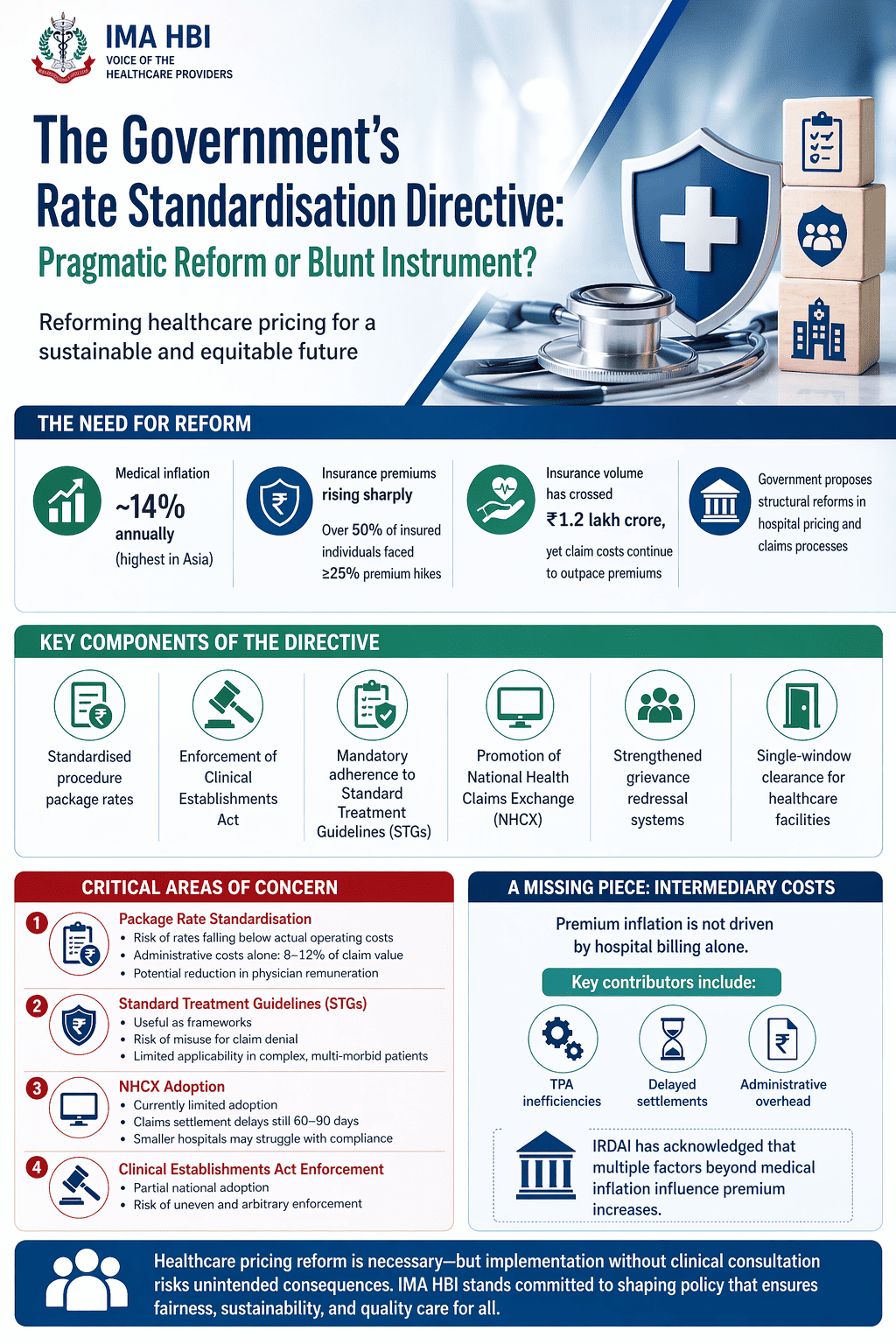
    India’s healthcare system is facing sustained financial pressure:

    Medical inflation: ~14% annually (highest in Asia)
    Insurance premiums rising sharply
    Over 50% of insured individuals faced ≥25% premium hikes

    Insurance volume has crossed ₹1.2 lakh crore, yet claim costs continue to outpace premiums.

    In response, the government has proposed structural reforms in hospital pricing and claims processes.

    Key Components of the Directive

    • Standardised procedure package rates
    • Enforcement of Clinical Establishments Act
    • Mandatory adherence to Standard Treatment Guidelines (STGs)
    • Promotion of National Health Claims Exchange (NHCX)
    • Strengthened grievance redressal systems
    • Single-window clearance for healthcare facilities

    Critical Areas of Concern

    1. Package Rate Standardisation
      Risk of rates falling below actual operating costs
      Administrative costs alone: 8–12% of claim value
      Potential reduction in physician remuneration

    2. Standard Treatment Guidelines (STGs)
      Useful as frameworks
      Risk of misuse for claim denial
      Limited applicability in complex, multi-morbid patients

    3. NHCX Adoption
      Currently limited adoption
      Claims settlement delays still 60–90 days
      Smaller hospitals may struggle with compliance

    4. Clinical Establishments Act Enforcement
      Partial national adoption
      Risk of uneven and arbitrary enforcement

    A Missing Piece: Intermediary Costs

    Premium inflation is not driven by hospital billing alone.

    Key contributors include:

    • TPA inefficiencies
    • Delayed settlements
    • Administrative overhead

    IRDAI has acknowledged that multiple factors beyond medical inflation influence premium increases.

    Discussion Questions for the Forum

    Q1. Were you involved in rate standardisation consultations? Was clinical input considered?

    Q2. Have STGs supported or restricted your clinical decision-making?

    Q3. Should IMA HBI submit a formal policy position to the Ministry?

    Q4. Is NHCX ready for large-scale implementation?

    Q5. Should regulatory focus extend equally to insurer and TPA inefficiencies?

    Healthcare pricing reform is necessary—but implementation without clinical consultation risks unintended consequences.

    If reforms shift cost burdens onto frontline providers without addressing systemic inefficiencies, the core problem remains unresolved.

    IMA HBI has both the authority and responsibility to shape this policy direction.

    Let this forum serve as the foundation for a structured, evidence-based position.


  • Hospital Licensing in India: Major Updates Across States (2025–2026) Healthcare Policy | Regulation | Hospital Licensing | India
    E EditorialTeam

    ChatGPT Image Apr 20, 2026, 12_39_46 PM.png

    India's hospital licensing landscape has seen some of the most significant regulatory changes in recent years heading into 2026. From state-level legislative amendments to new national-level compliance mandates, here is a comprehensive roundup of everything healthcare administrators, hospital owners, and policy watchers need to know.

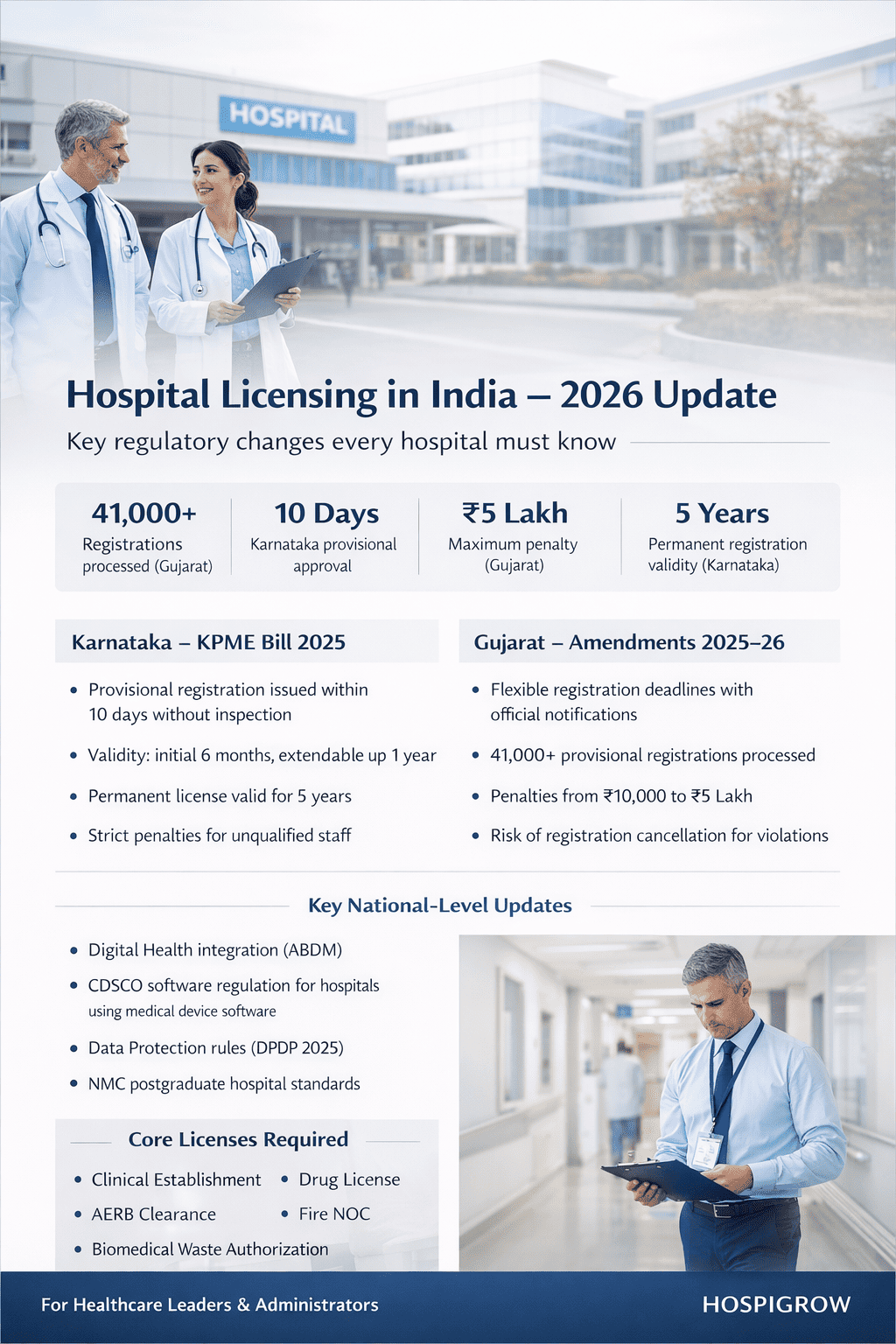
    Key Numbers at a Glance

    41,000+ provisional registrations processed in Gujarat (as of March 2026)
    10 days — provisional certificate timeline under Karnataka's 2025 bill
    ₹5 lakh — maximum penalty for non-compliance in Gujarat
    5 years — permanent registration validity under Karnataka's new rules

    Background: The Regulatory Framework
    Hospital licensing in India operates at two levels — central and state. The Clinical Establishments (Registration and Regulation) Act, 2010 serves as the backbone at the national level, standardising facilities and services across clinical establishments in states that have adopted it. Meanwhile, individual states run their own parallel registration systems through State Health Departments, and compliance requires navigating both layers.
    Additionally, several procedure-specific clearances are required — from the Atomic Energy Regulatory Board (AERB) for radiology, the Central Drugs Standard Control Organization (CDSCO) for blood banks, and NABL for clinical labs. Fire NOCs, building plan approvals, biomedical waste authorizations, and drug licenses are all mandatory pre-requisites.

    State-wise Updates
    Karnataka
    The Karnataka government passed the Karnataka Private Medical Establishments (Amendment) Bill, 2025 in the Legislative Assembly in December 2025 — one of the most sweeping state-level changes in recent years. Key highlights:

    A new provisional registration system where private hospitals, clinics, and diagnostic centres receive a provisional certificate within 10 days of applying, without any inspection.
    Provisional registration is valid for six months, renewable — but cannot be extended beyond one year from when government standards are notified.
    Permanent registration, once granted, will be valid for five years.
    New private clinical labs are prohibited within 200 metres of government hospitals.
    Facilities accredited by NABH, NQAS, QAI, or certified by the Quality Council of India (QCI) will receive registration or renewal within 10 days without inspection.
    Strict 3-year imprisonment clause and fine up to ₹1 lakh for employing unqualified doctors or paramedical staff.

    Source: Medical Dialogues — https://medicaldialogues.in/news/health/hospital-diagnostics/karnataka-passes-private-medical-establishments-amendment-bill-2025-key-highlights-160952

    Gujarat
    Gujarat has been especially active on the compliance front. The Gujarat Clinical Establishment (Second Amendment) Act, 2025 (notified September 2025) extended the registration deadline for all existing health institutions to April 30, 2026.
    Subsequently, in March 2026, the Gujarat Assembly passed the Gujarat Clinical Establishments (Registration and Regulation) (Amendment) Bill, 2026 — making registration deadlines flexible. Rather than hard-coding dates into law, the state government can now set and update deadlines via official gazette notifications, removing the need for fresh legislation each time a deadline needs extending.
    As of March 20, 2026, Gujarat had processed around 41,000 provisional registrations and about 2,000 permanent registrations. Penalties remain in place: fines from ₹10,000 to ₹5 lakh, with registration cancellation for serious violations.
    Sources:

    DeshGujarat (2026): https://deshgujarat.com/2026/03/25/gujarat-clinical-establishment-amendment-bill-passed-registration-deadline-rules-changed/
    DeshGujarat (2025): https://deshgujarat.com/2025/02/21/gujarat-clinical-establishment-registration-and-regulation-amendment-bill-2025-passed-in-state-assembly/
    Bombay Samachar: https://english.bombaysamachar.com/gujarat/no-more-fake-doctors-gujarat-assembly-passes-clinical-establishment-amendment-bill-2026/

    Karnataka — Emergency Care Rules
    Separately from the KPME amendment, Karnataka issued new emergency care guidelines in early 2026 under the Karnataka Good Samaritan and Medical Professional (Protection and Regulation During Emergency Situations) Rules, 2026, published on February 12, 2026. Private healthcare providers are now required to provide emergency services — covering road traffic accidents, fire-related injuries, and gunshot wounds — without demanding upfront payments from patients.
    Source: IndiaLaw — https://www.indialaw.in/blog/medico-legal/karnataka-good-samaritan-rules-2026/

    National Medical Commission (NMC) — Teaching Hospital Update
    As of March 11, 2026, the NMC published a revised notice updating certain Postgraduate Minimum Standards of Requirements (PGMSR-2023) concerning postgraduate training programs in teaching hospitals that also function as clinical establishments. This has direct licensing implications for medical colleges with attached hospitals.
    Source: OpenPR / Corpseed — https://www.openpr.com/news/4431310/india-strengthens-clinical-establishment-regulations-in-2026

    Key National-Level Updates

    • Digital Health & Mandatory Portals
      The Ayushman Bharat Digital Mission continues to push hospitals toward digital registration and health record integration. Under Karnataka's KPME bill, hospitals are required to register on the e-DAR portal to share patient data and medical reports in road accident cases — a preview of how digital compliance is becoming tied to licensing.
    • CDSCO Medical Device Software Guidance (October 2025)
      The Central Drugs Standard Control Organization released draft guidance on Medical Device Software (MDS), introducing a risk-based classification system aligned with ISO 13485. Hospitals deploying AI-driven diagnostics or software-based medical devices now face an additional compliance layer under the Medical Devices Rules, 2017.
      Source: https://www.mavenrs.com/blog/india-medical-device-software-regulation-cdsco-samd-2026
    • GMP Compliance for Pharma (Extended Deadline)
      The deadline for small and medium pharmaceutical companies to comply with revised Good Manufacturing Practices under Schedule M of the Drugs and Cosmetics Act was extended to December 31, 2025.
      Source: Arogya Legal — https://arogyalegal.com/2025/latest-updates/top-5-health-laws-and-policy-updates-156/
    • Digital Personal Data Protection Rules, 2025
      Released by MeitY, these rules operationalize the DPDP Act 2023 and have significant implications for hospitals that store electronic health records — adding fresh requirements around data localization and storage timelines.

    Core Licenses Required (2026 Checklist)
    Every hospital in India must have the following in place:

    • Clinical Establishment License (state-issued, 3–5 year validity)
    • Drug License under the Drugs and Cosmetics Act, 1940
    • AERB clearance for radiology equipment (X-ray, CT, MRI) — can take 3–6 months
    • Fire NOC (provisional before construction, final after completion)
    • Building Plan Approval under National Building Code 2016
    • Biomedical Waste Authorization
    • Pollution Control Board Consent
    • NABH Accreditation (technically optional but increasingly required for insurance empanelments)

    Source: Actiss Healthcare — https://www.actisshealthcare.com/licenses-required-start-hospital-india

    Important Note for Hospital Operators
    The licensing process varies significantly between states — what applies in Karnataka may not apply in Maharashtra or Tamil Nadu. Engaging a local compliance consultant with state-specific knowledge is strongly recommended, especially given that inspections, AERB approvals, and fire safety verifications all run on different timelines.

    What to Watch in 2026

    • Karnataka's KPME amendments need state-level standards to be notified before provisional registrations convert to permanent — that timeline will be closely watched.
    • Gujarat's flexible deadline framework may be emulated by other states.
    • The NMC's PGMSR updates will continue affecting teaching hospitals through 2026.
    • The CDSCO's MDS guidance, currently in draft, is expected to be finalized, triggering new compliance requirements for hospitals using software-driven diagnostics.

    For the healthcare community, staying on top of these developments is no longer optional — regulatory non-compliance increasingly carries criminal liability, not just fines.

    All References

    Medical Dialogues — Karnataka KPME Amendment Bill 2025: https://medicaldialogues.in/news/health/hospital-diagnostics/karnataka-passes-private-medical-establishments-amendment-bill-2025-key-highlights-160952
    DeshGujarat — Gujarat CE Amendment Bill 2026: https://deshgujarat.com/2026/03/25/gujarat-clinical-establishment-amendment-bill-passed-registration-deadline-rules-changed/
    DeshGujarat — Gujarat CE Amendment Bill 2025: https://deshgujarat.com/2025/02/21/gujarat-clinical-establishment-registration-and-regulation-amendment-bill-2025-passed-in-state-assembly/
    OpenPR / Corpseed — India Clinical Establishment Regulations 2026: https://www.openpr.com/news/4431310/india-strengthens-clinical-establishment-regulations-in-2026
    IndiaLaw — Karnataka Good Samaritan Rules 2026: https://www.indialaw.in/blog/medico-legal/karnataka-good-samaritan-rules-2026/
    Hospitech Healthcare — Hospital Licensing Guide 2025: https://www.hospitechhealth.com/nabh/getting-your-hospital-licensed-in-india-a-realistic-guide-for-2025/
    Mavenrs — CDSCO Medical Device Software Regulation 2026: https://www.mavenrs.com/blog/india-medical-device-software-regulation-cdsco-samd-2026
    Arogya Legal — Top 5 Health Laws & Policy Updates 2025: https://arogyalegal.com/2025/latest-updates/top-5-health-laws-and-policy-updates-156/
    Legal 500 — Code of Care: India's Key Healthcare Laws: https://www.legal500.com/developments/thought-leadership/code-of-care-an-overview-of-indias-key-healthcare-laws/
    Actiss Healthcare — Licenses Required to Start a Hospital in India: https://www.actisshealthcare.com/licenses-required-start-hospital-india
    Bombay Samachar — Gujarat CE Amendment Bill 2026: https://english.bombaysamachar.com/gujarat/no-more-fake-doctors-gujarat-assembly-passes-clinical-establishment-amendment-bill-2026/
    ICLG — Digital Health Laws & Regulations India 2025–2026: https://iclg.com/practice-areas/digital-health-laws-and-regulations/india

    Disclaimer: This post is for informational purposes only and does not constitute legal advice. Always consult a qualified healthcare compliance professional for state-specific guidance.Sonnet 4.6

  • 📢 IMA Karnataka Special Membership Drive 2026 — 75% Discount | Last Date: 30th April
    E EditorialTeam

    WhatsApp Image 2026-04-20 at 00.12.12.jpeg
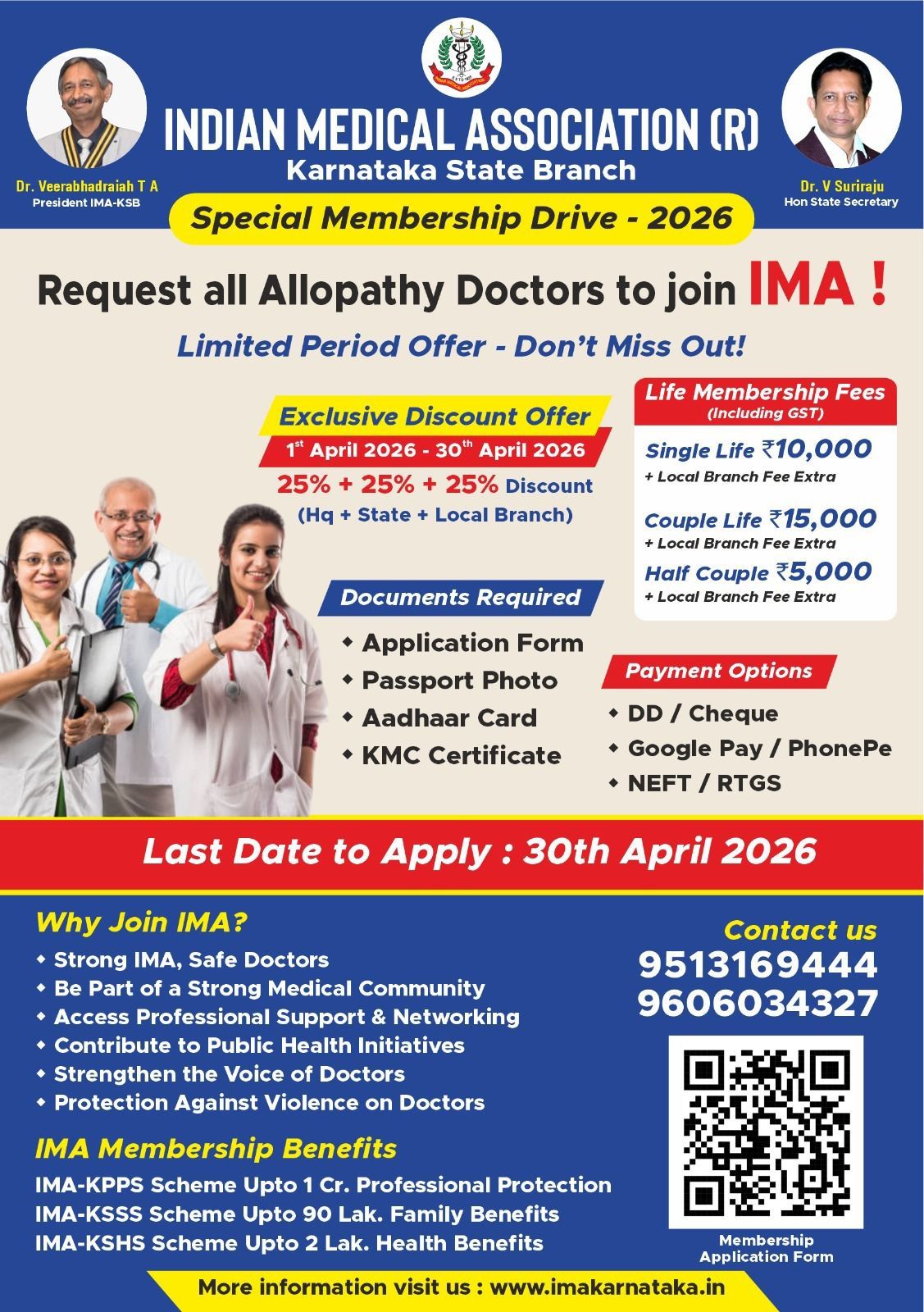
    Greetings from the Indian Medical Association (R) – Karnataka State Branch!

    We are pleased to announce our Special Membership Drive 2026, an exclusive limited-period initiative to welcome all eligible Allopathy Doctors into the IMA family at a significantly reduced cost.

    🎯 EXCLUSIVE DISCOUNT OFFER

    📅 Valid: 1st April 2026 – 30th April 2026
    💥 Discount: 25% + 25% + 25% (HQ + State + Local Branch) = 75% Combined Discount

    💳 LIFE MEMBERSHIP FEES (Including GST)

    • Single Life Membership → ₹10,000 (+ Local Branch Fee)
    • Couple Life Membership → ₹15,000 (+ Local Branch Fee)
    • Half Couple Membership → ₹5,000 (+ Local Branch Fee)

    📋 DOCUMENTS REQUIRED

    1. Completed Application Form
    2. Passport Size Photograph
    3. Aadhaar Card (copy)
    4. KMC Registration Certificate

    💰 PAYMENT OPTIONS
    • DD / Cheque
    • Google Pay / PhonePe
    • NEFT / RTGS

    🛡️ WHY JOIN IMA?
    ✔ Strong IMA = Safe Doctors
    ✔ Be part of a powerful medical community
    ✔ Access professional support & peer networking
    ✔ Contribute to public health initiatives
    ✔ Strengthen the collective voice of doctors
    ✔ Protection against violence on doctors

    🎁 IMA MEMBERSHIP BENEFITS
    🔹 IMA-KPPS Scheme — Professional Protection up to ₹1 Crore
    🔹 IMA-KSSS Scheme — Family Benefits up to ₹90 Lakhs
    🔹 IMA-KSHS Scheme — Health Benefits up to ₹2 Lakhs

    ⏰IMPORTANT DEADLINE
    Last Date to Apply: 30th April 2026
    Do not miss this once-in-a-year opportunity!

    📞 CONTACT US

    Phone: 9513169444 / 9606034327
    Website: www.imakarnataka.in
    (Scan QR code on the flyer for direct membership application)

    We urge all Allopathy Doctors who have not yet joined IMA to take advantage of this exceptional offer. Together, a stronger IMA means better protection, better representation, and better healthcare for all.

    Warm regards,
    Dr. Veerabhadraiah T A — President, IMA-KSB
    Dr. V Suriraju — Hon. State Secretary, IMA-KSB
    Indian Medical Association (R), Karnataka State Branch


  • What every doctor and hospital owner needs to know about KPME
    E EditorialTeam

    ChatGPT Image Apr 19, 2026, 10_17_24 PM (1).png
    Understanding Karnataka Private Medical Establishments Act for hospitals

    The Karnataka Private Medical Establishments (KPME) Act, 2007 was enacted to replace the older Karnataka Private Nursing Home (Regulation) Act, 1976 and bring comprehensive legal control over all private healthcare in the state. ¹
    It covers: Hospitals (all bed strengths), Clinics (even single-doctor OPDs), Diagnostic centres (labs, imaging), Dental clinics, Physiotherapy centres, and AYUSH establishments. ²

    COMMON MISCONCEPTION
    "It's a small clinic — KPME registration doesn't apply to me."
    This is one of the most expensive assumptions a doctor can make. Under Section 3 of the KPME Act, no private medical establishment can be established, run, or maintained without valid registration — regardless of size. A single-room OPD with one doctor is covered. Size doesn't change the rule. ³

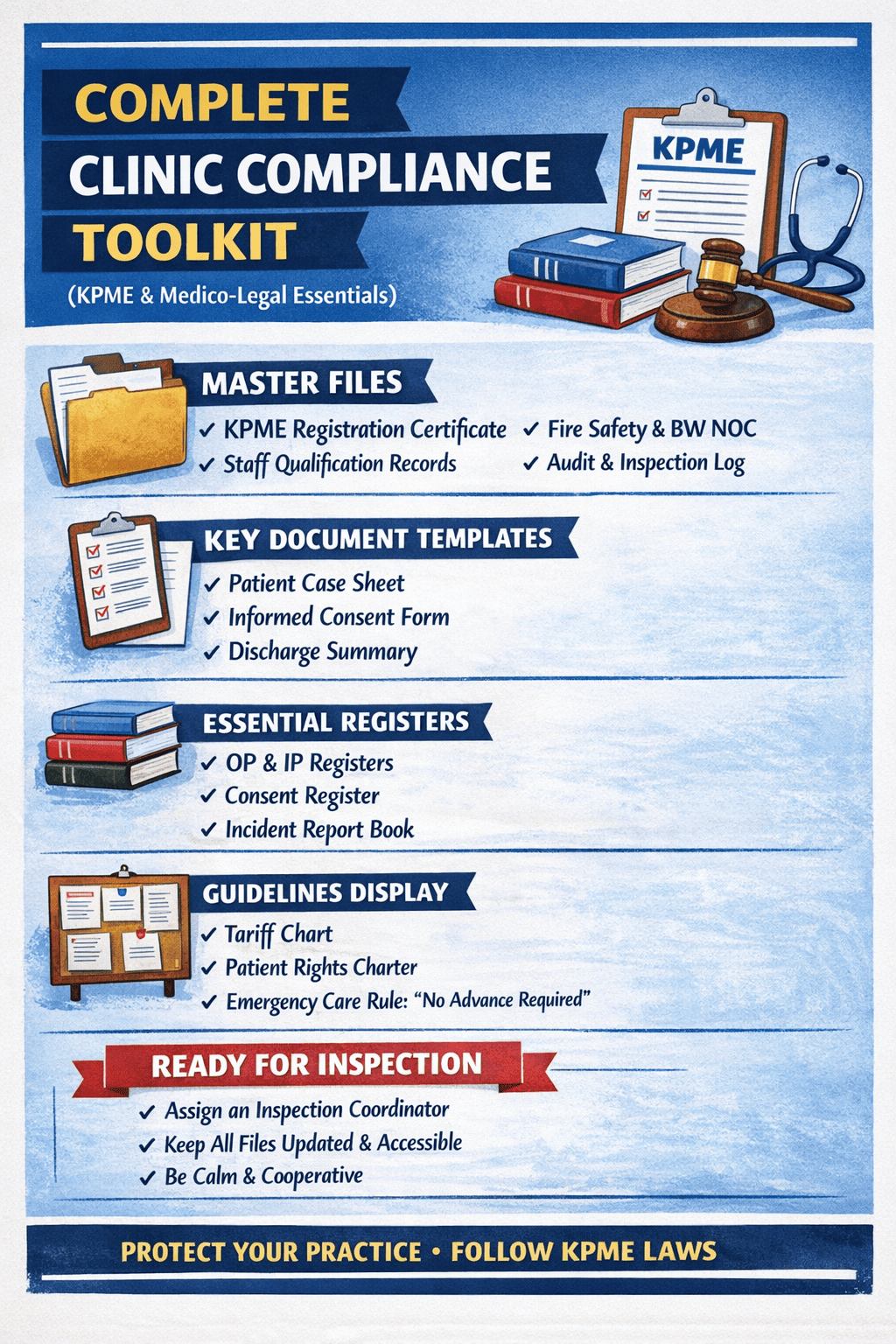
    COMPLIANCE CHECKLIST
    Every private medical establishment must ensure: ⁴
    ✔ KPME registration certificate displayed at the premises
    ✔ Rate/tariff chart publicly visible to patients (Section 10 — Schedule of Charges)
    ✔ Patient Rights Charter displayed
    ✔ Clinical records properly maintained and shareable on request (Section 13)
    ✔ Active biomedical waste tie-up with an authorised vendor
    ✔ Valid fire safety NOC
    ✔ Staff qualification records available for inspection (Section 8 — Local Inspection Committee)

    FOUR RULES MOST OFTEN VIOLATED

    1. Emergency treatment (Section 12)
      Hospitals must not insist on advance payment when a patient is brought in as an emergency — this covers RTA, poisoning, burns, and assault cases. ⁵
    2. Release of bodies
      A deceased patient's body cannot be withheld over unpaid bills. Release is mandatory and immediate. ⁶
    3. Clinical records (Section 13)
      Patients have a full legal right to copies of their own clinical records on payment of copy charges. Refusal is a direct offence under the Act. ⁴
    4. Rate display (Section 10)
      All charges must be clearly displayed for patients and the general public. Hidden or unlisted pricing is a KPME violation. ³

    PENALTIES
    The 2017 Amendment (enacted as Act 01 of 2018, Gazette Notification HFW 11 FPR 2018, dated 27.03.2018) substantially enhanced penalties: ⁷
    Under Section 19 of the KPME Act: ⁸

    Operating without registration → imprisonment up to 3 years + fine
    Contravening conditions of registration, or violating Section 12 (emergency) or Section 13 (records) → imprisonment up to 6 months + fine; repeat offence → up to 1 year + higher fine
    The 2017/2018 Amendment further proposed enhancement of penalties from a few thousands to lakhs, including imprisonment for hospital managers in cases of overcharging beyond fixed rates ⁷

    Ground reality (2025): The KPME Registration and Grievance Redressal Authority (RGRA) has already taken action — 39 medical establishments in Bengaluru were identified for violations, fines ranging from ₹10,000 to ₹1 lakh were imposed (total: ₹7.35 lakh), one clinic was recommended for seizure, and FIRs were directed against two establishments. ⁹

    WHO CAN INSPECT YOUR CLINIC?
    Under Section 8 of the KPME Act, the Registration and Grievance Redressal Authority (RGRA) at the district level may constitute one or more Local Inspection Committees (LIC). ⁸ These bodies can inspect with or without prior notice and may act on patient complaints. The manager of the establishment must provide all reasonable facilities for inspection.

    WHERE MEDICO-LEGAL CASES ACTUALLY START
    Most doctors assume legal trouble comes from a treatment error. In practice, the majority of cases today stem from something far more preventable.
    Documentation gaps. Consent issues. Billing disputes. KPME non-compliance. These are the real triggers — and every single one is within your control to fix before a complaint lands.

    REPLY BELOW

    Is your clinic fully KPME compliant? What did you check first?
    Have you faced an inspection or received a notice?
    What is the biggest compliance challenge for your setup?
    Should IMA create a standard KPME compliance toolkit for Karnataka doctors?

    If you run a clinic or hospital in Karnataka, do a compliance audit today. A few hours of review now is far cheaper than an inspection notice later.

    REFERENCES
    ¹ IAS Abhiyan — What is the KPME Amendment Bill — https://www.iasabhiyan.com/kpme-amendment-bill/
    ² Karnataka State Physiotherapy Federation — KPME Act applicability — https://www.karnatakaphysio.org/KPVMEA.html
    ³ India Code — The Karnataka Private Medical Establishments Act, 2007 (Act 21 of 2007) — https://www.indiacode.nic.in/bitstream/123456789/7097/1/21_of_2007(e).pdf
    ⁴ Dr. Devadasan — Myths and Facts about KPME — https://kpmeyake.wordpress.com/2017/11/18/718/
    ⁵ GK Today — KPME Amendment Bill, 2017 — https://www.gktoday.in/kpme-amendment-bill-2017/
    ⁶ KPME Yake — Citizens' response to KPME Rules 2018 — https://kpmeyake.wordpress.com
    ⁷ Government of Karnataka, Health & Family Welfare — KPME Rules 2018, Gazette Notification HFW 11 FPR 2018, dated 27.03.2018 — https://karunadu.karnataka.gov.in/hfw/pages/kpme_act.aspx
    ⁸ Karnataka High Court / Indian Kanoon — Dr. Veeresh vs State of Karnataka (Crl.A.No.2648/2019) — reproducing Section 8, 10, 19 of KPME Act — https://indiankanoon.org/doc/160134813/
    ⁹ Medical Dialogues — 39 medical establishments fined for violating KPME Act, Bengaluru (March 2025) — https://medicaldialogues.in/news/health/hospital-diagnostics/39-medical-establishments-fined-for-violating-kpme-act-144414


  • ⚖️ Nurses’ Strike in Kerala: Legal Battle, Ethical Dilemma & Patient Safety
    E EditorialTeam

    Nurses' strike_ patient care vs. rights (1).png

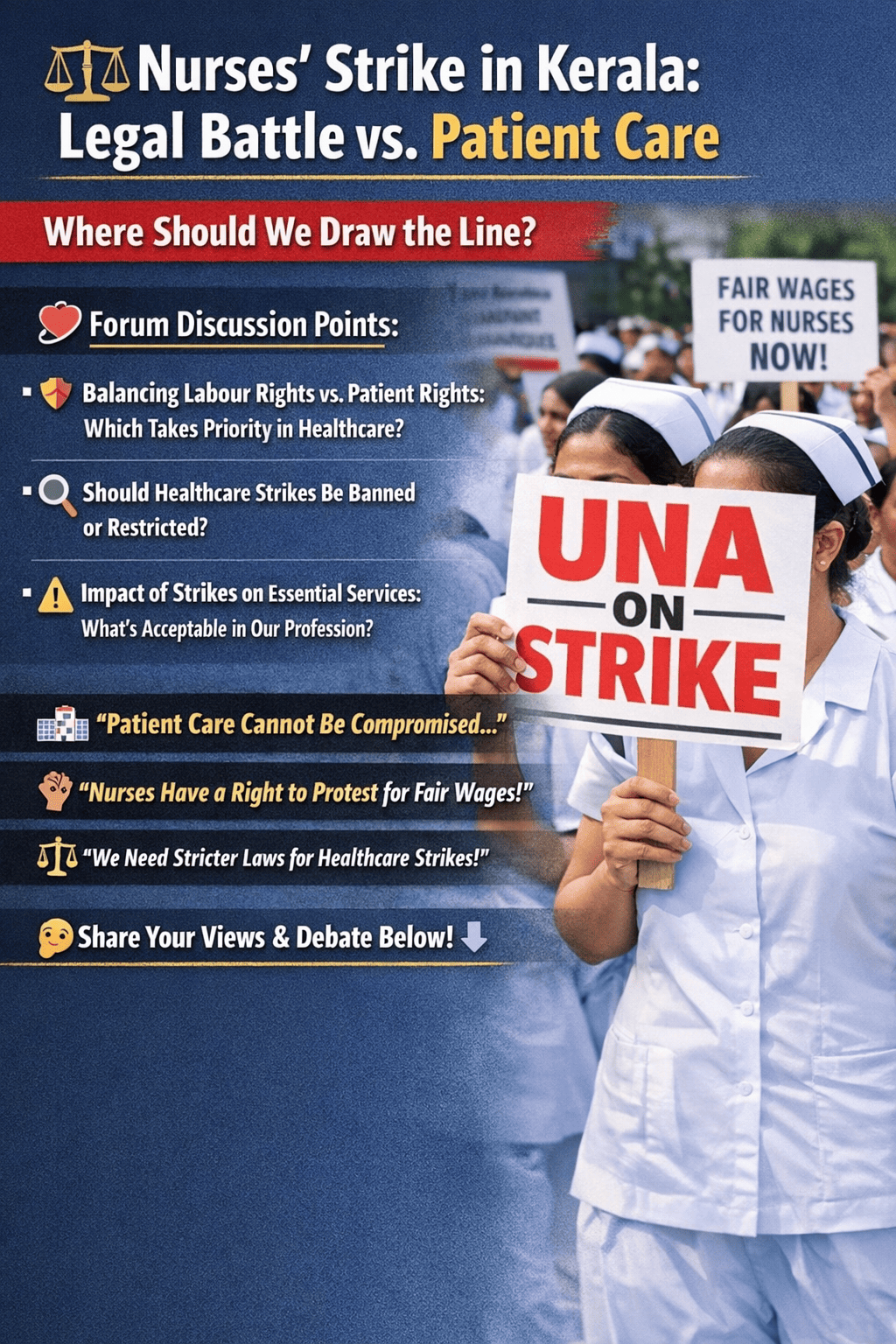
    A crucial issue impacting the healthcare ecosystem is currently unfolding in Kerala, where the ongoing nurses’ strike has raised serious legal, ethical, and clinical concerns.
    The Kerala Private Hospitals Association has approached the High Court, arguing that the strike led by the Kerala United Nurses Association is unlawful and amounts to an unfair labour practice, particularly due to non-compliance with provisions of the Industrial Relations Code, 2020.
    The matter is being heard by Justice M. A. Abdul Hakhim, with key concerns centered around:
    • Absence of mandatory notice period
    • Strike during ongoing conciliation
    • Disruption of essential healthcare services
    Hospitals have also highlighted that such actions may fall under the ambit of the Essential Services Maintenance Act, given the direct impact on patient care and public safety.

    🏥 Ground Reality: Beyond Law, It’s About Lives
    While the protest is described as peaceful, the complete withdrawal of nursing services has significantly reduced hospital functionality, affecting critical patient care.
    This raises a fundamental concern:
    In healthcare, even a short disruption is not just operational—it can be life-threatening.

    ⚖️ The Core Conflict
    This issue is not black and white.
    On one side:
    • Nurses demanding fair wages and dignified working conditions
    On the other:
    • Patients depending on continuous, uninterrupted care
    “A system that fails its caregivers cannot sustain quality care.”
    “But a system that halts care risks failing its patients irreversibly.”

    🔥 Questions We Cannot Ignore
    • Can healthcare be treated like any other industry when it comes to strikes?
    • Should the right to protest extend to complete service shutdowns?
    • Is it time to legally mandate minimum essential services during strikes?
    • Are we, as a system, addressing grievances before they escalate?

    💡 What This Means for IMA & Healthcare Leaders
    This is not just a state-specific issue—it reflects a national policy gap.
    There is an urgent need to:
    • Define clear legal boundaries for healthcare strikes
    • Protect both workforce rights and patient safety
    • Establish structured conflict resolution mechanisms
    • Consider regulated protest models instead of total shutdowns

    🗣️ IMA Forum Discussion – Your Expert Opinion Matters

    1. Should healthcare strikes be banned or strictly regulated in India?
    2. What minimum services must remain non-negotiable during such protests?
    3. Should IMA advocate for a national policy on healthcare strikes?
    4. What practical, immediate solutions can prevent such crises?

    📌 Final Thought
    Healthcare is not just a profession—it is a responsibility where every delay has consequences.
    Let’s use this discussion to move beyond debate and toward solutions that protect both caregivers and patients.


  • New PMJAY rule bars many cancer specialists from treating patients
    E EditorialTeam

    PMJAY cancer specialist eligibility infographic (1).png
    Discussion from HBI desk👇

    🏥 New PMJAY Rule Restricting Cancer Specialists – A Growing Concern

    A recent policy change under Ayushman Bharat Pradhan Mantri Jan Arogya Yojana (PMJAY) has raised serious concerns across the medical community.

    🔍 What’s the Issue?

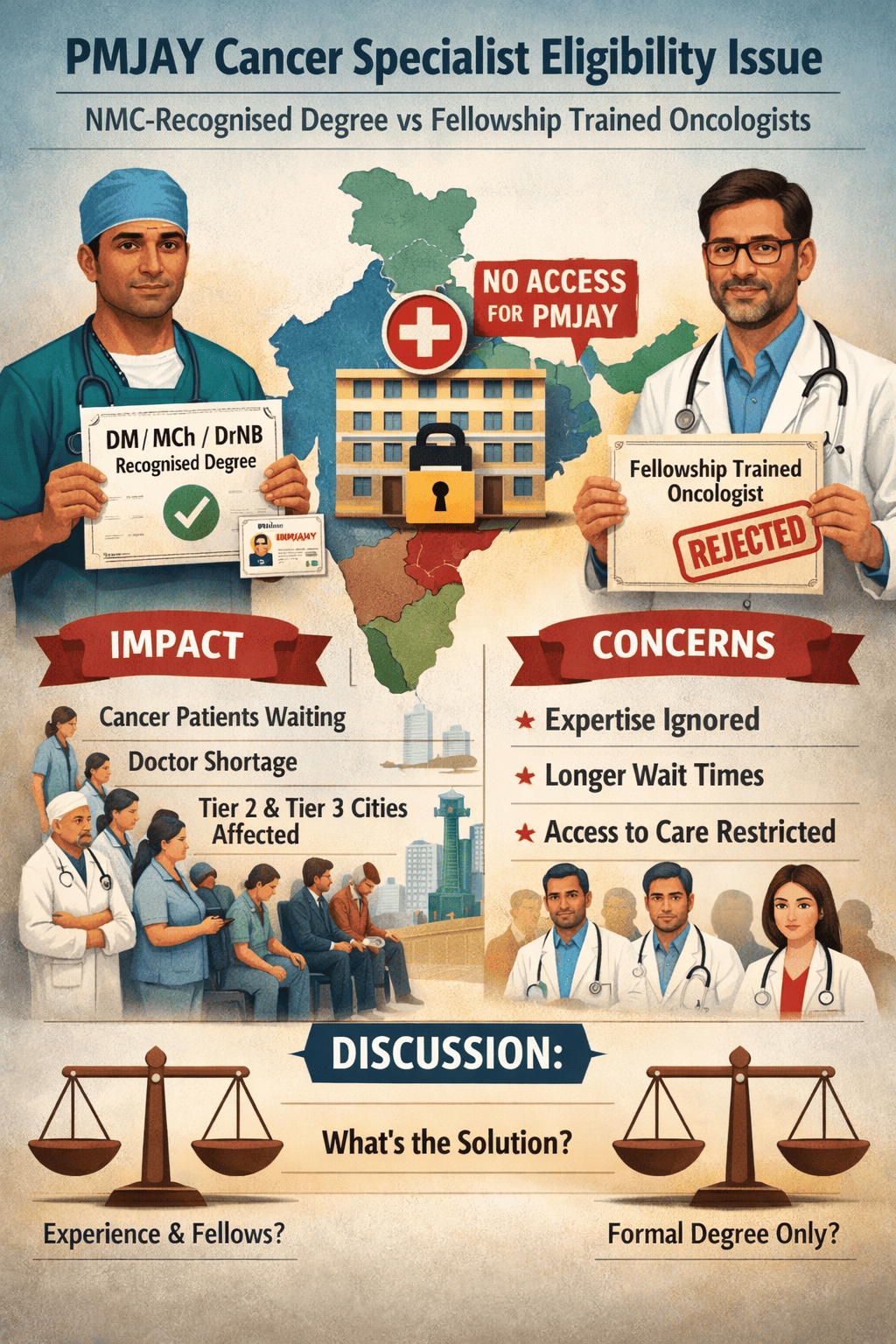
    A new eligibility rule now restricts many experienced cancer specialists from treating PMJAY patients. The key reason:

    • Only doctors with NMC-recognised super-speciality degrees (DM/MCh/DrNB) are being allowed
    • Fellowship-trained oncologists, despite years of experience, are being excluded

    📊 Why This Matters

    • India sees ~15 lakh (1.5 million) new cancer cases annually

    • There is already a severe shortage of oncologists

    • Many excluded doctors:

      • Have decades of clinical experience
      • Have served as department heads, teachers, and senior surgeons
      • Have even trained DM/DrNB specialists

    👉 Despite this, they are now ineligible under PMJAY

    ⚠️ Ground-Level Impact

    • Reduced access to cancer care, especially in tier-2 and tier-3 cities

    • Longer waiting times for PMJAY patients

    • Hospitals may:

      • Remove such specialists from PMJAY panels
      • Terminate contracts due to inability to process claims

    📉 Example: In some cities, majority of available cancer surgeons are fellowship-trained, meaning large patient groups may lose access entirely.

    🧠 Background of the Policy Conflict

    • Earlier (pre-2018), oncology training largely depended on fellowships due to limited DM/MCh seats

    • These fellowships were widely accepted in practice and academia

    • Post transition from MCI to National Medical Commission (NMC):

      • Only formal degrees are recognised
      • Fellowships are not clearly included in eligibility criteria

    🏛️ Current Situation

    • Confusion between:

      • National Health Authority (NHA) (empanels hospitals)
      • NMC (decides qualifications)
    • No clear clarification issued yet

    • Medical associations (including Indian Medical Association (IMA)) have raised concerns


    💬 Key Concerns Raised

    • ❗ Policy may be ignoring real-world expertise
    • ❗ Retrospective application affecting already practicing specialists
    • ❗ Could worsen cancer care accessibility, especially for poor patients

    What are your thoughts on this?

    1. Should experience + fellowship training be considered equivalent to formal degrees?
    2. Is this rule practical in India’s current oncology workforce scenario?
    3. Will this lead to centralization of cancer care in metro cities?
    4. How should policymakers balance standardization vs accessibility?

    👉 Share your views, experiences, or policy suggestions

    News from ETHealthworld👇
    New PMJAY Rule Excludes Experienced Cancer Specialists, Impacting Patient Care, ETHealthworld https://health.economictimes.indiatimes.com/news/industry/new-pmjay-rule-bars-many-cancer-specialists-from-treating-patients/130048832


  • Karnataka government mandates blood bank tie-ups, on-site doctors for maternity hosps
    E EditorialTeam

    129837349.jpg

    Read more at:
    https://health.economictimes.indiatimes.com/news/policy/karnataka-government-mandates-blood-bank-tie-ups-on-site-doctors-for-maternity-hosps/129836991


  • Preventing medicolegal issues in clinical Practice
    E EditorialTeam

    preventing medicolegal issues in clinical practice.pdf


  • Social Media Misreads Supreme Court Observation on DAMA — IMA-HBI Leaders Forum Clarifies for Doctors
    E EditorialTeam

    “Social Media Misreads Court Order on DAMA — IMA HBI Leaders Forum Brings Clarity for Doctors”

    Clarification on DAMA / LAMA Misinterpretation

    Recent discussions on social media have created confusion regarding Discharge Against Medical Advice (DAMA/LAMA) after observations made by the Supreme Court of India.

    The Court has not banned DAMA, nor has it stated that hospitals or doctors will be criminally liable for every DAMA discharge. Patients and families still have the legal right to leave a hospital against medical advice due to personal choice, financial reasons, or transfer to another facility.

    What the Court emphasized is that DAMA should not be misused as a routine shortcut, especially in terminal or end-of-life situations. In such cases, hospitals should follow proper medical and legal procedures under the framework laid down in Common Cause v. Union of India and reaffirmed in the recent judgment Harish Rana v. Union of India, which discusses withdrawal or withholding of life-sustaining treatment through a structured medical decision-making process.

    In simple terms:
    DAMA remains legally valid, but hospitals must ensure ethical practice, transparent communication with families, and proper end-of-life care protocols instead of using DAMA as a substitute for medical decision-making.

    Here is a copy of court verdict
    SC judgment on Passive Euthanasia Harish Rana vs Union of India Misc application 2238 of 2025 judgment dated 11 March 2026.pdf


  • Are Small Hospitals Disappearing in the Current Healthcare Environment?
    E EditorialTeam

    Proper training of staff

  • Login

  • Don't have an account? Register

  • First post
    Last post
0
  • Categories
  • Recent
  • Tags
  • Popular
  • Users
  • Groups