Common compliance mistakes hospitals make — from small clinics to large healthcare systems
-
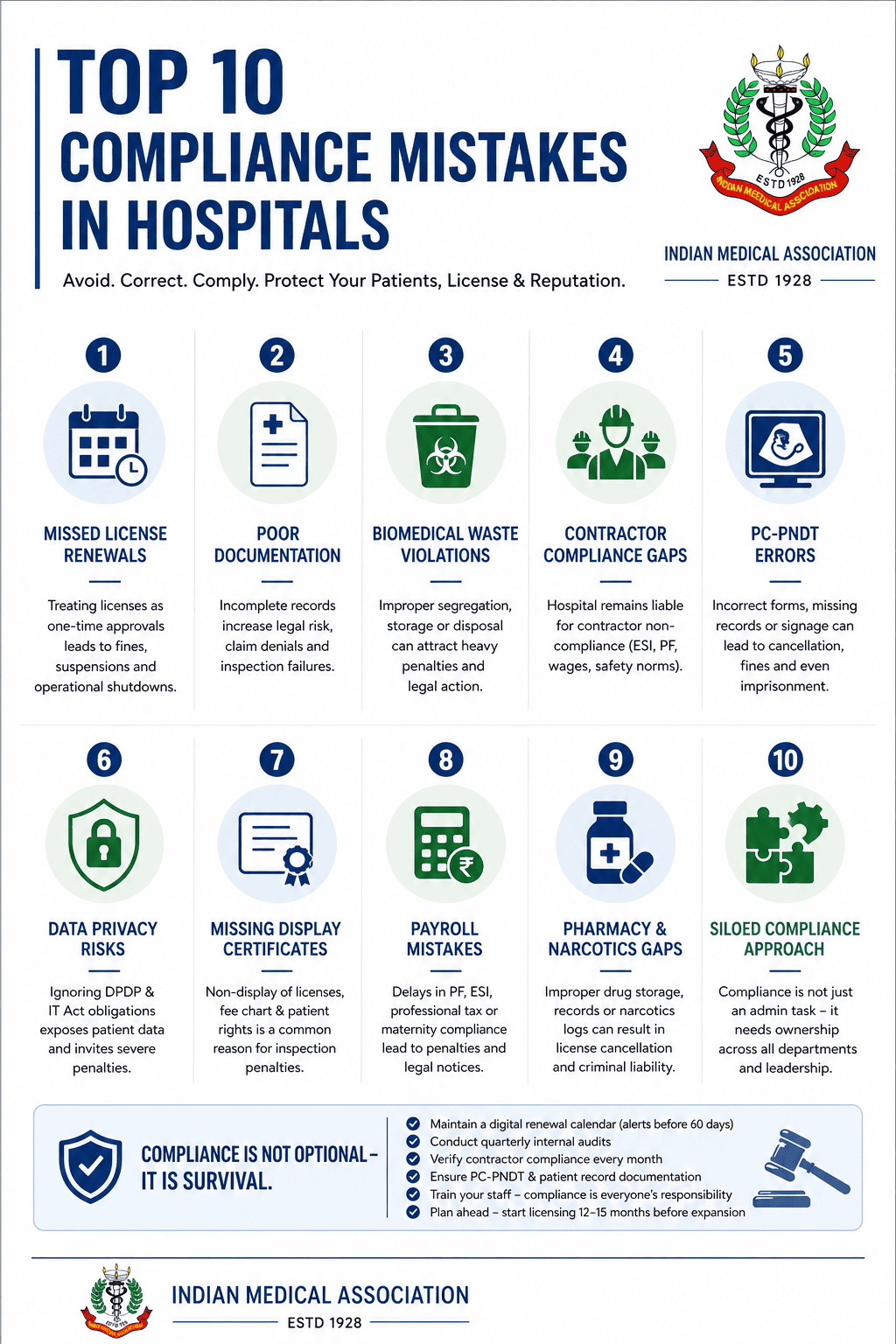
Healthcare compliance is one of the most underestimated operational burdens in the industry. Whether you run a 5-bed nursing home in a tier-2 city or a 500-bed multi-specialty hospital in a metro, statutory compliance is non-negotiable. Non-compliance doesn't just attract fines — it can result in license cancellations, criminal liability, and most critically, harm to patients. This post maps the full landscape: what laws apply, how they scale across facility size, and what mistakes are commonly made at each level.
Part 1 — The regulatory framework (India-specific)
India's healthcare compliance operates under a dual framework — central laws and state-specific rules. Every clinical establishment must navigate both simultaneously. The key statutes are:
Clinical Establishments Act, 2010
All facilities — registration, minimum standards, renewals
Drugs & Cosmetics Act, 1940
Any facility with in-house pharmacy or blood bank
Bio-Medical Waste Rules, 2016
All facilities generating clinical waste
PC-PNDT Act, 1994
Any facility offering ultrasound or prenatal diagnostics
AERB Regulations
Facilities with X-ray, CT, MRI — 3-6 month clearance process
NABL / NABH Accreditation
Labs and hospitals — voluntary but often mandatory for insurance empanelment
Labour Laws (PF, ESI, Maternity, Contract Labour)
All employers — scaled by staff headcount
IT Act & DPDP Act
Any facility using EHR or digital health records
Consumer Protection Act, 1986
All doctor-patient interactions — medical negligence liability
Fire Safety & Building NOC
All hospitals — mandatory periodic renewalPart 2 — How compliance scales by facility size
Small clinic / nursing home- Clinical Establishment registration
- MCI / state council registration display
- Drug license (if pharmacy)
- GST registration
- Local municipality NOC
- PC-PNDT (if ultrasound)
- Basic bio-waste authorization
- PF/ESI if 10+ employees
Mid-size / single-specialty hospital - All of the above, plus:
- AERB clearance for imaging
- Blood bank license
- Fire NOC (periodic renewal)
- Labour law full compliance
- Pollution control board NOC
- Narcotics license (if applicable)
- Vehicle registration (ambulance)
- NABL for labs
Large / multi-specialty hospital - All of the above, plus:
- NABH accreditation
- Effluent treatment plant compliance
- IT Act / DPDP data governance
- Corporate law compliance (Companies Act)
- POSH Act internal committee
- Cyber security audit
- Insurance empanelment compliance
- 59+ FTEs dedicated to compliance
Part 3 — The most common compliance mistakes
1. Treating registration as a one-time activity
The single most universal mistake across all facility sizes. Clinical Establishment registration, fire NOC, drug licenses, and AERB approvals all require periodic renewal. One missed renewal date can trigger heavy fines or departmental closure. Most small clinics manage this manually via spreadsheets — which breaks down as operations scale.
All sizesClinical Establishments ActFire NOC2. Poor documentation and record-keeping
Incomplete progress notes, missing doctor signatures, and inadequate patient records are among the top reasons for billing claim denials and legal liability. Under the IMC Regulations 2002, records of patient treatment, narcotics usage, and employment hours must be maintained. Inspectors under the Clinical Establishments Act 2010 can demand these at any time — and missing documentation invites prosecution.
All sizesIMC RegulationsFalse Claims risk3. Biomedical waste management failures
Many hospitals — especially small ones — fail to maintain proper waste segregation infrastructure. The Bio-Medical Waste Rules 2016 require color-coded bins, authorized disposal contracts, proper ventilation in storage areas, and detailed waste logs. Large hospitals must also maintain on-site treatment systems. Non-compliance here triggers Pollution Control Board action and can result in criminal liability.
All sizesBMW Rules 2016CPCB / SPCB4. Contract labour compliance gaps
Most hospitals outsource housekeeping, security, and cafeteria services. A critical mistake is assuming the contractor's compliance is not the hospital's problem. Under the Contract Labour Act, the hospital as principal employer bears liability if the contractor fails to pay workers or provide statutory benefits. This affects everything from ESI contributions to safety protocols.
Mid-size & largeContract Labour ActESI / PF5. PC-PNDT non-compliance for imaging services
Any facility offering ultrasound — even a small clinic — must register under the PC-PNDT Act. Mistakes include failing to update records when a radiologist resigns, not maintaining Form F for every ultrasound examination, and poor signage compliance. Authorities conduct surprise inspections, and penalties include imprisonment for repeat offences. This is one of the most frequently prosecuted areas.
Any facility with ultrasoundPC-PNDT Act 19946. Digital data privacy oversight
With India's Digital Personal Data Protection Act now in effect, hospitals handling electronic health records have new obligations. Many facilities use third-party software, tracking pixels on websites, or cloud storage without adequate data processing agreements. Sharing patient data with unauthorized parties — even unintentionally — creates serious liability. Small clinics using basic EHR tools are equally covered.
All digital facilitiesDPDP ActIT Act7. Inadequate display of licenses and patient rights****
A basic but commonly overlooked requirement: every clinical establishment must visibly display its Clinical Establishment registration certificate, doctors' council registration certificates, fee schedules, and patient rights. Inspectors routinely flag missing or expired displayed certificates. Patients not informed of their rights under the Patient Care Partnership expose hospitals to consumer forum complaints.
All sizesClinical Establishments ActConsumer Protection Act8. Payroll and statutory deduction errors
Small errors in PF computation, delayed ESI deposit, or non-registration of contract workers can lead to cumulative penalties. Hospitals with manual payroll systems frequently miss cut-off dates for statutory remittances. Large hospitals face additional complexity from shift-based rosters and multi-category workforce classifications (doctors, nurses, paramedics, admin) each attracting different legal thresholds.
All employersPF ActESI ActMaternity Benefit Act9. Pharmacy and narcotics record failures
Hospitals with in-house pharmacies must maintain a drug license under the Drugs and Cosmetics Act 1940 and keep detailed records of narcotic and psychotropic substance consumption under the NDPS Act. Common failures include expired drug licenses, absent qualified pharmacist records, and missing narcotics logs. These are criminal offences, not merely administrative lapses.
Any facility with pharmacyDrugs Act 1940NDPS Act10. Treating compliance as a single department's job
Perhaps the most structural mistake in large hospitals. Compliance cannot sit in one office — it requires active participation from clinical, administrative, HR, IT, and facilities teams. When compliance is siloed, critical cross-cutting risks (a whistleblower false claims case, a data breach, a waste management audit) are missed. Building a culture of proactive compliance — not reactive damage control — is what separates resilient institutions from vulnerable ones.
Mid-size & largeOrganizationalAll statutesPart 4 — A practical compliance readiness checklist
- Maintain a digital renewal calendar for all licenses with 60-day advance alerts
- Conduct quarterly internal audits of documentation completeness (patient records, employee registers, waste logs)
- Verify contractor compliance monthly — obtain PF and ESI challan copies from every outsourced vendor
- Update PC-PNDT Form F records for every ultrasound — keep registers at point of service
- Display all certificates, fee charts, and patient rights in prominent locations — photograph and date each display board annually
- Review data sharing agreements with all third-party software vendors for DPDP Act alignment
- Train all staff — not just compliance officers — on PHI confidentiality, incident reporting procedures, and patient rights
- For new or expanding facilities: begin licensing 12-15 months before planned opening — especially for AERB clearances
Sources consulted:
Clinical Establishments Act 2010, Bio-Medical Waste Rules 2016, PC-PNDT Act 1994, Drugs & Cosmetics Act 1940, MYND Integrated Solutions compliance guide, ACTISS Healthcare licensing guide, Gratitude Healthcare compliance overview, AHA Regulatory Overload Report, NAVEX healthcare compliance analysis, HFMA compliance professional insights.This post is for informational purposes — consult a qualified healthcare legal advisor for facility-specific guidance.